Description
Ready to Dispatch — This 45 degree automatic edge banding machine in stock is wired for your local voltage and shipped with the control language your operators actually read, verified before it leaves our Ningjin workshop.
Technical Specifications
| Parameter | Value |
|---|---|
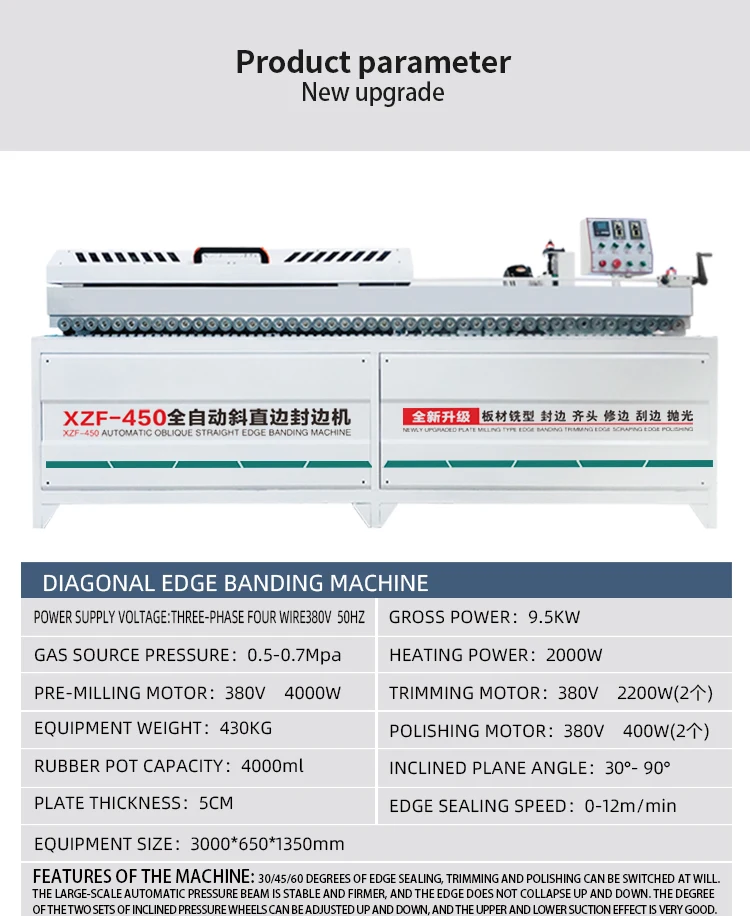
| Model | XZF450 |
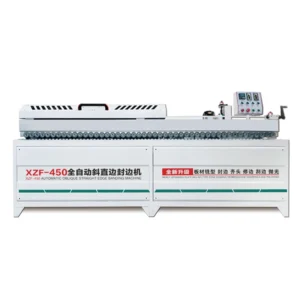
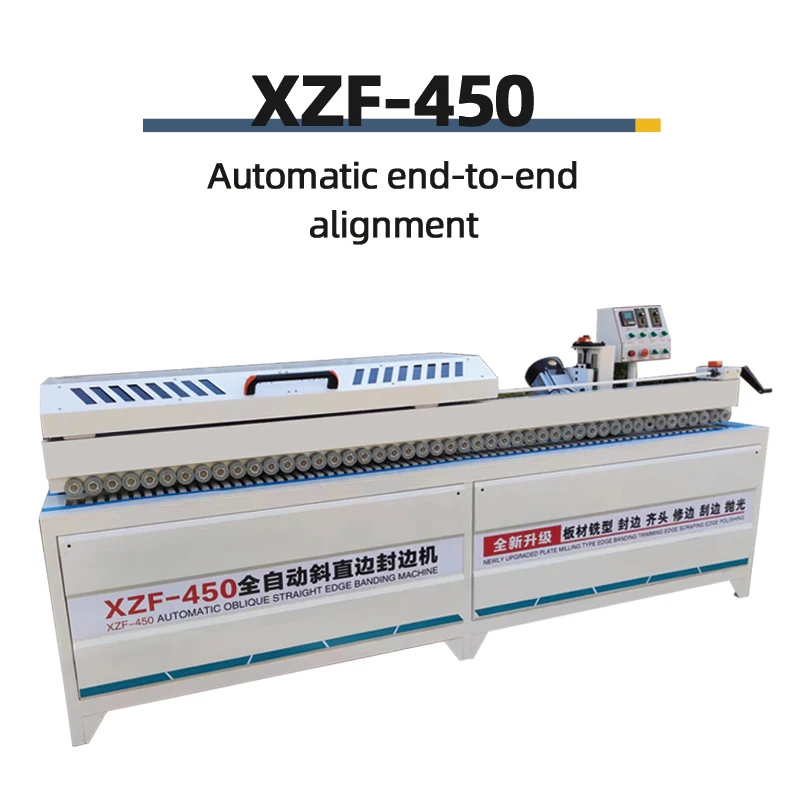
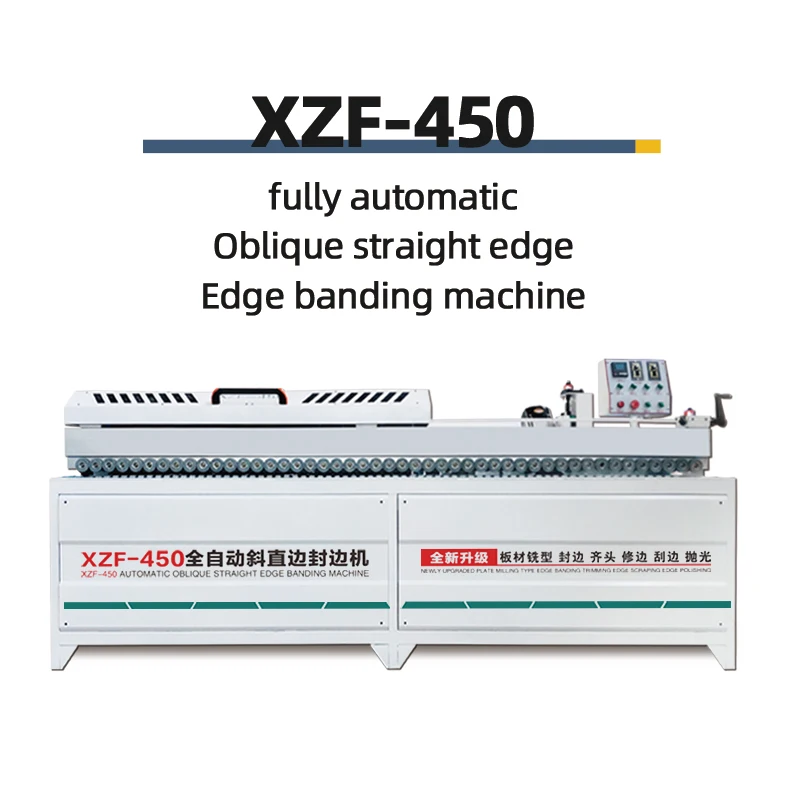
| Product Type | 45 Degree Automatic Edge Banding Machine |
| Total Installed Power | 9.5 kW |
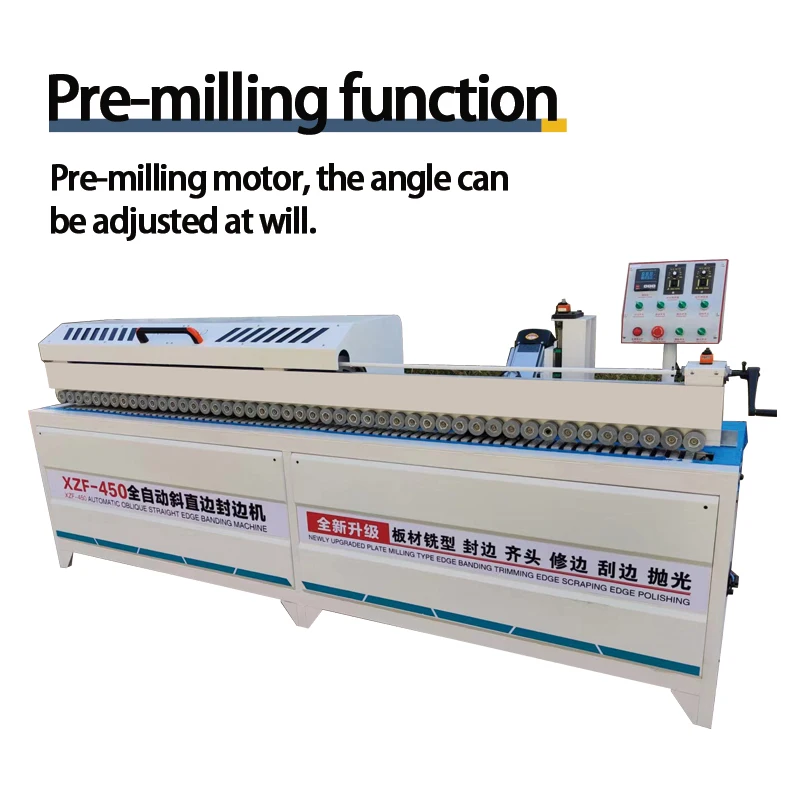
| Pre-milling Motor | 4 kW |
| Trimming Motors | 2.2 kW × 2 |
| Polishing Motors | 0.4 kW × 2 |
| Edge Banding Motor / Speed | 0.16 kW / 0–12 m/min |
| Transmission Motor / Speed | 180 W / 0–12 m/min |
| Vacuum Motor | 550 W |
| Glue Pot Capacity | 4000 ml |
| Standard Voltage | 380 V / 415 V (configurable from 110 V to 440 V) |
| Air Source Pressure | 0.5–0.7 MPa |
| Edge Banding Height | 0–50 mm |
| Edge Banding Thickness | 0.3–3 mm |
| Minimum Sheet Length | 300 mm |
| Minimum Sheet Width | 150 mm |
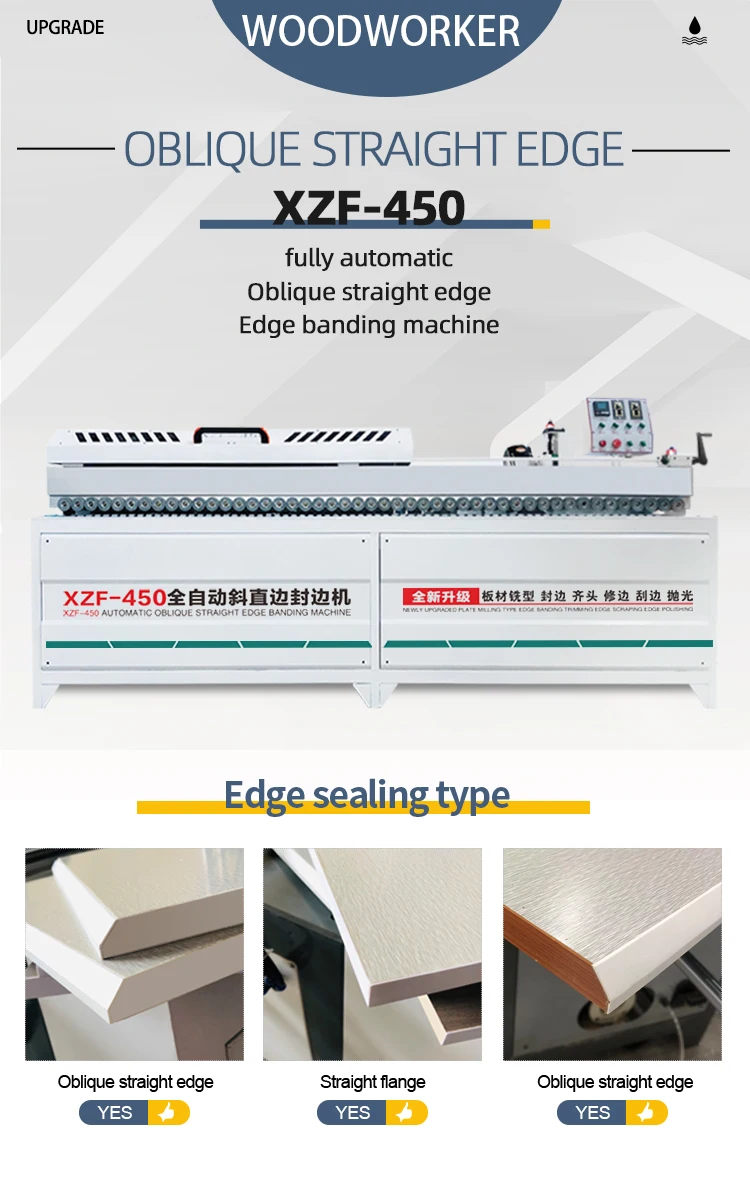
| Supported Angles | 30° / 45° / 60° and 90° |
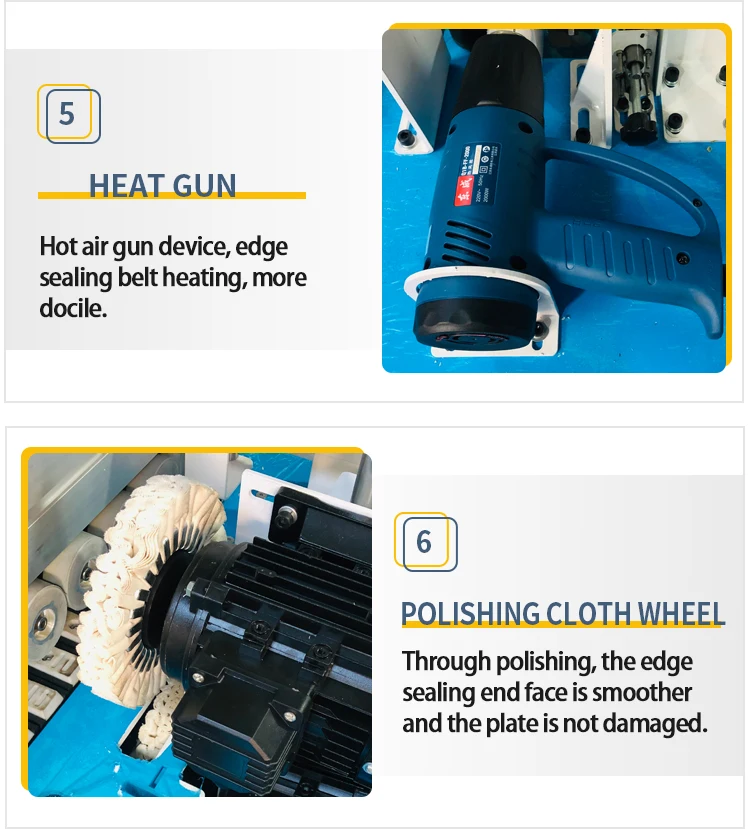
| Working Stations | Pre-milling, gluing, end trimming, rough & fine trimming, scraping, polishing, vacuum extraction |
| Overall Dimensions (L×W×H) | 3000 × 650 × 1350 mm |
| Net Weight | 430 kg |
| Control Panel Language | English, Chinese (customizable to Spanish or other languages) |
| Plug Standard Options | EU, USA, AU, UK |
| Certification | CE, ISO 9001 |
Application Suitability
| Application | Material or Output |
|---|---|
| 45° and 90° cabinet door edge banding | MDF, melamine-faced board, plywood |
| Custom furniture angled-edge profiles | Particleboard, blockboard with PVC or veneer edge banding |
| Polymer door and panel edge finishing | Solid wood board, polymer composite panels |
| Medium-volume workshop production runs | Board feed up to 50 mm height, 0.3–3 mm banding thickness |
Why Voltage Confirmation Matters Before You Hit "Order"
A 45 degree automatic edge banding machine in stock means nothing if it arrives wired for a grid your factory does not have. Confirming voltage, frequency, and plug type before production starts is the single step that prevents a machine from sitting idle on your floor.
I have watched crated machines sit in Southeast Asian and South American ports for weeks because the buyer assumed 380 V was universal. The transformer retrofit alone cost more than the shipping, and the delay pushed delivery commitments back by an entire month. The XZF450 is configurable from 110 V to 440 V, but that flexibility only helps if we lock the correct specification before the wiring harness goes in [NEED_CITE: voltage and frequency standards by export market]. Every order we process starts with a written voltage and frequency confirmation matched to your facility’s electrical panel.
Stock Means Ready, Not Rushed
When a buyer searches for a 45 degree automatic edge banding machine in stock, the priority is usually a production gap that needs filling fast. The XZF450 is held in inventory at our Ningjin facility and can be dispatched on a compressed timeline once the electrical and language specifications are confirmed. This is not a build-to-order cycle where you wait for a production slot to open up.
That said, fast dispatch does not mean skipping checks. Each unit goes through a pre-shipment test run on the board thickness and edge banding material you specify, so the machine you receive has already processed your exact substrate before it is crated.
Dispatch Lead Time and What Happens During It
The advantage of ordering from ready stock is predictable scheduling. Once your voltage, plug type, and control panel language are confirmed in writing, the unit moves to the test bay. We run a full cycle — pre-milling, gluing, trimming, scraping, and polishing — on your chosen material and document the results.
Packing photographs and the factory test record are shared before the crate is sealed. This is where most miscommunication happens in international machinery trade, and we close that gap by making the pre-shipment verification visible to you [NEED_CITE: CE machinery directive requirements for industrial equipment]. You know exactly what is in the crate before it reaches the port.
How the Specifications Translate on the Shop Floor
The 4 kW pre-milling motor is the first station the board encounters, and its job is to remove any surface irregularity or saw blade tear-out left by the panel saw. Without adequate pre-milling power, the glue does not bond uniformly, and you get visible seams on melamine and plywood substrates. The XZF450 allocates nearly half its total power budget to this single station, which directly affects edge quality on rough-cut boards.
The feed speed range of 0–12 m/min gives operators room to slow down for thick veneer banding at 45° angles and speed up for standard PVC runs at 90°. The trimming section uses dual 2.2 kW motors for rough and fine passes, which is what separates a clean flush edge from one that needs hand-sanding before the panel moves to assembly.
The 4000 ml glue pot capacity supports continuous production runs without frequent refills, which matters when you are feeding boards through back-to-back in a batch cycle. The air pressure requirement of 0.5–0.7 MPa is standard for pneumatic clamping and trimming actuators, so most workshops with an existing compressor will not need additional air infrastructure.
What Happens When Specifications Are Assumed
Buying a single machine to fill a gap, without checking feed height or throughput compatibility with your existing line, is one of the most common mistakes I see in mid-size furniture workshops. The panels come off the edge bander at a rate your downstream drilling station cannot absorb, or the minimum sheet width of 150 mm is too large for the small cabinet components you produce daily.
Last year, a veneer splicing trimmer shipped to a Southeast Asian buyer who tested samples on PVC but ran solid wood veneer in production. The glue temperature and trimming blade angles were wrong for the actual material, and it took two days of on-site adjustment before the line produced acceptable output. Now I ask every buyer: what material are you actually running [NEED_CITE: edge banding glue temperature requirements for veneer vs PVC substrates]? Getting this answer right before the machine ships saves far more time than any dispatch speed advantage.
Why Buyers Source This Machine from Our Stock Inventory
Voltage and language customization is treated as standard procedure, not an upsell. The XZF450 ships configured for your electrical grid and with a control panel your operators can read, whether that is English, Spanish, or another specified language.
The seven-station configuration is complete within one product family, so a workshop adding capacity does not need to integrate equipment from different manufacturers with mismatched feed heights. The pre-milling, trimming, and polishing stations are engineered to work at the same throughput rate.
Pre-shipment testing runs your actual board and banding material through the full cycle before crating. You receive the factory test record and packing photographs before the machine leaves the workshop.
CE and ISO 9001 documentation is included as standard, and we support customs clearance paperwork specific to your destination country. This removes the documentation bottleneck that delays machinery imports in regulated markets.
Documentation & Verification
- CE declaration of conformity matching the XZF450 unit serial number for customs clearance
- Factory test record on your specified board thickness and edge banding material before dispatch
- Electrical schematic confirming your voltage, frequency, and plug configuration
- Operation and maintenance manual in your agreed control panel language
- Spare parts list with part numbers for consumable blades and polishing wheels
- Packing photographs showing crate condition and accessory placement before sealing
Installation, Commissioning & Support
- Requires a level concrete floor with clearance for the 3000 mm footprint plus operator access on both sides
- Dedicated 380 V / 415 V circuit rated for 9.5 kW total draw with appropriate breaker protection
- Arrives fully assembled; connect compressed air at 0.5–0.7 MPa and power before first run
- Initial glue pot temperature and feed speed calibration matched to your first production material
- Operator walk-through covering angle changeover between 30°, 45°, 60°, and 90° profiles
- Consumable trimming blades and polishing pads identified in the spare parts list for reorder planning
Before You Send Your Inquiry
To configure the XZF450 correctly for your workshop, share the board materials and thicknesses you process most frequently, your facility voltage and frequency, and the edge banding material type you run in daily production. If you are integrating this machine into an existing line, let us know the feed height and throughput of your upstream and downstream stations so we can confirm compatibility before the order is placed.
Frequently Asked Questions
Q: Is the XZF450 currently in stock, and how soon can it ship?
A: Yes, this model is held in ready stock at our Ningjin facility. After you confirm voltage, plug type, and control panel language, the unit goes through a pre-shipment test on your specified material. Dispatch typically follows within a short window after testing and crating are complete. Exact timing depends on the configuration scope and destination port scheduling.
Q: My factory runs on a non-standard voltage — can the machine be customized?
A: The XZF450 is configurable from 110 V to 440 V. We confirm your exact voltage and frequency in writing before the wiring harness is installed. Control panel language is also customizable to English, Spanish, or other specified languages, so your operators can commission the machine without translation delays.
Q: What are the minimum board dimensions this machine accepts?
A: The minimum sheet length is 300 mm and the minimum width is 150 mm. Edge banding height covers 0–50 mm with banding thickness from 0.3 to 3 mm. If your production includes components smaller than these minimums, share your board dimensions with us before ordering so we can confirm suitability.
Q: Does switching between 45° and 90° edge banding require tooling changes?
A: The XZF450 supports 30°, 45°, 60°, and 90° angles within its standard configuration. Angle changeover involves adjusting the banding feed guide and trimming station settings, which operators can complete without swapping out major tooling. The operation manual includes step-by-step procedures for each angle profile.
Q: What support is available after the machine arrives at our facility?
A: We provide remote installation guidance covering power and air connections, initial calibration, and first-run procedures. The operation manual and spare parts list ship with the machine in your agreed language. Our team remains available for troubleshooting as your operators move through the commissioning phase and into regular production.