Description
Fast-Dispatch Readiness — every stocked unit is electrically verified against your site’s actual supply before it leaves the Shandong floor, preventing the dead-on-arrival surprises that stall workshop commissioning.
Technical Specifications
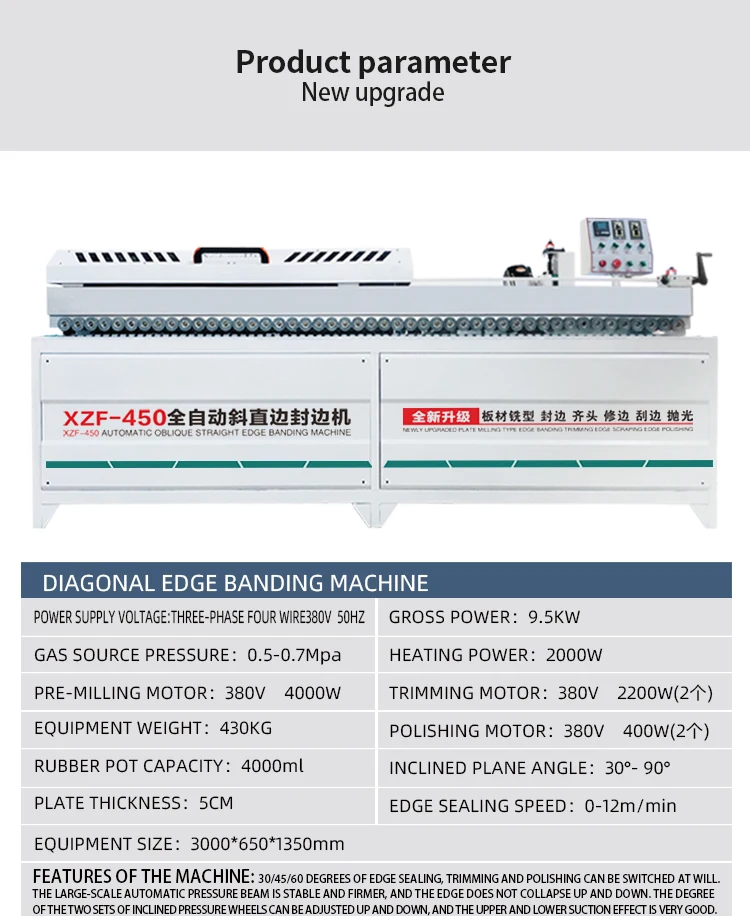
| Parameter | Value |
|---|---|
| Model | XZF-450 |
| Product Type | Automatic Edge Banding Machine |
| Total Installed Power | 9.5 kW |
| Pre-milling Motor | 4 kW |
| Trimming Power | 2.2 kW × 2 |
| Polishing Power | 0.4 kW × 2 |
| Edge Feeding Power | 0.16 kW |
| Transmission Power | 180 W |
| Vacuum Power | 550 W |
| Voltage Configuration | 380V / 415V (frequency and phase to be confirmed per site) |
| Feed Speed Range | 0–12 m/min |
| Edge Banding Height Range | 0–50 mm |
| Edge Banding Thickness Range | 0.3–3 mm |
| Minimum Sheet Length | 30 cm |
| Minimum Sheet Width | 15 cm |
| Glue Pot Capacity | 4000 ml |
| Required Air Source Pressure | 0.5–0.7 MPa |
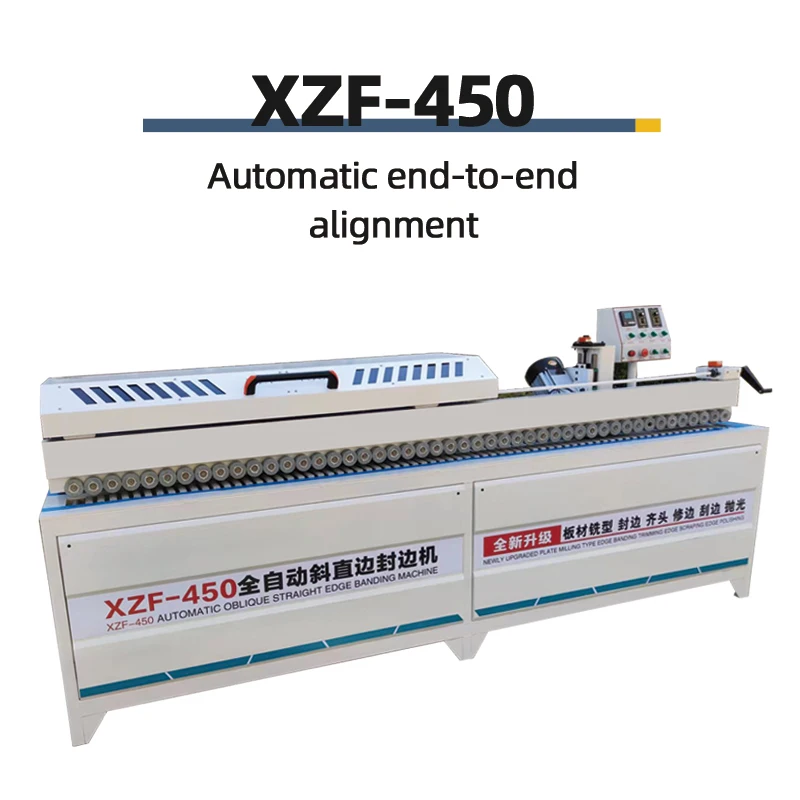
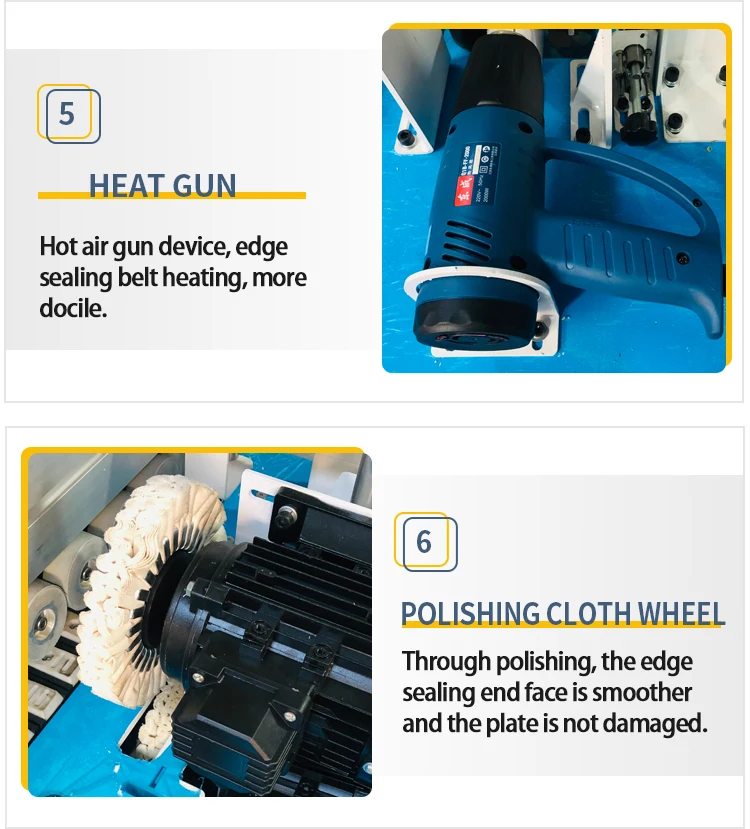
| Standard Processing Stations | Pre-milling, gluing, end trimming, rough trimming, finish trimming, scraping, polishing, vacuum extraction |
| Overall Dimensions (L×W×H) | 300 × 65 × 135 cm |
| Net Weight | 430 kg |
| Control Panel Language | Chinese and English standard; other languages configurable |
| Plug Options | EU, USA, AU, UK |
Application Suitability
| Application | Material or Output |
|---|---|
| Cabinet door and carcass edge finishing | MDF, melamine-faced board, particleboard |
| Custom furniture panel processing | Plywood, blockboard, solid wood panels |
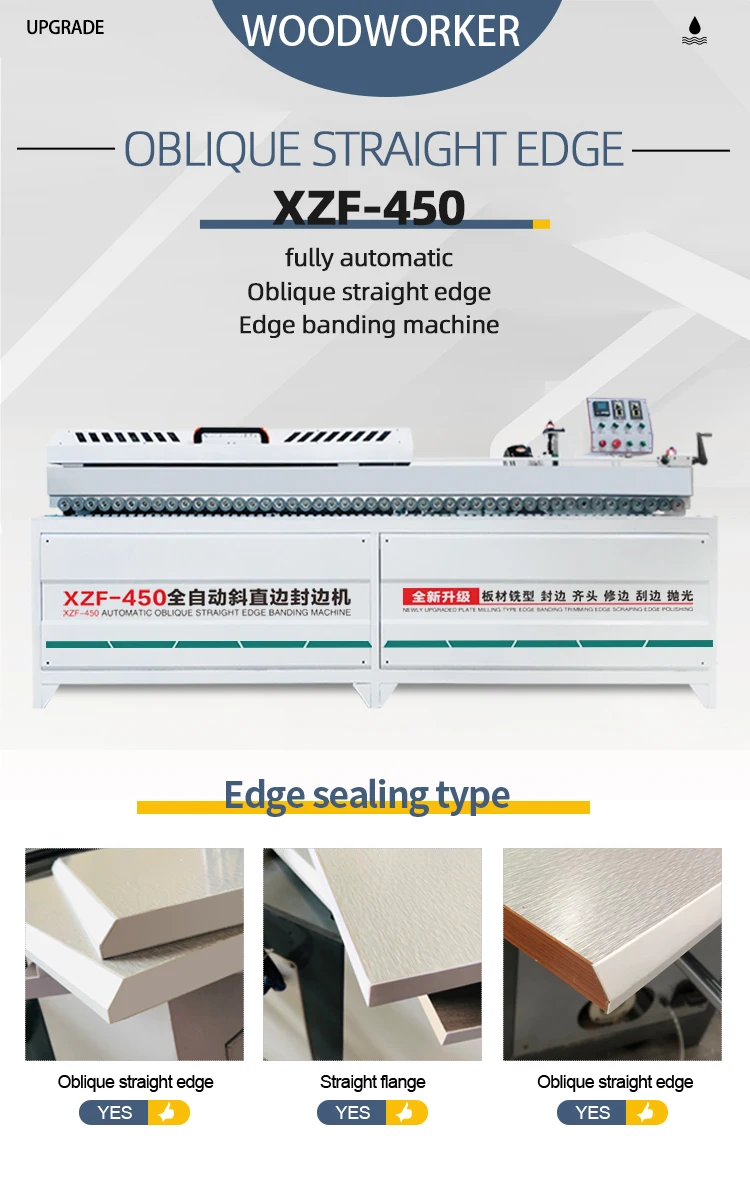
| Angled edge profiles for designer joinery | 30°, 45°, and 60° bevel banding on polymer and veneer strips |
| Polymer door and interior panel production | PVC and polymer composite sheets |
| Medium-volume batch runs | Sustained output on standard board thicknesses within 0.3–3 mm banding range |
Why Voltage Confirmation Must Precede the Purchase Order
A machine that cannot match your local grid is not a bargain — it is a crate of idle steel.
I learned this the hard way when a unit shipped to a Middle East customer arrived with a 120V configuration, only for the site to run on 60Hz rather than 50Hz. The control panel threw fault codes on first power-up, and the workshop stood idle for nearly three weeks waiting for a replacement inverter [NEED_CITE: voltage and frequency standards by export market]. When you search for an automatic edge banding machine in stock, the listing may look ready to go, but the electrical side still demands a deliberate check against your actual supply. Skipping that step turns a fast delivery promise into an extended installation headache.
What Ready Stock Actually Means for Your Workshop
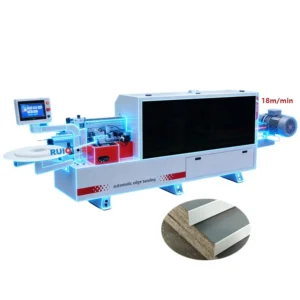
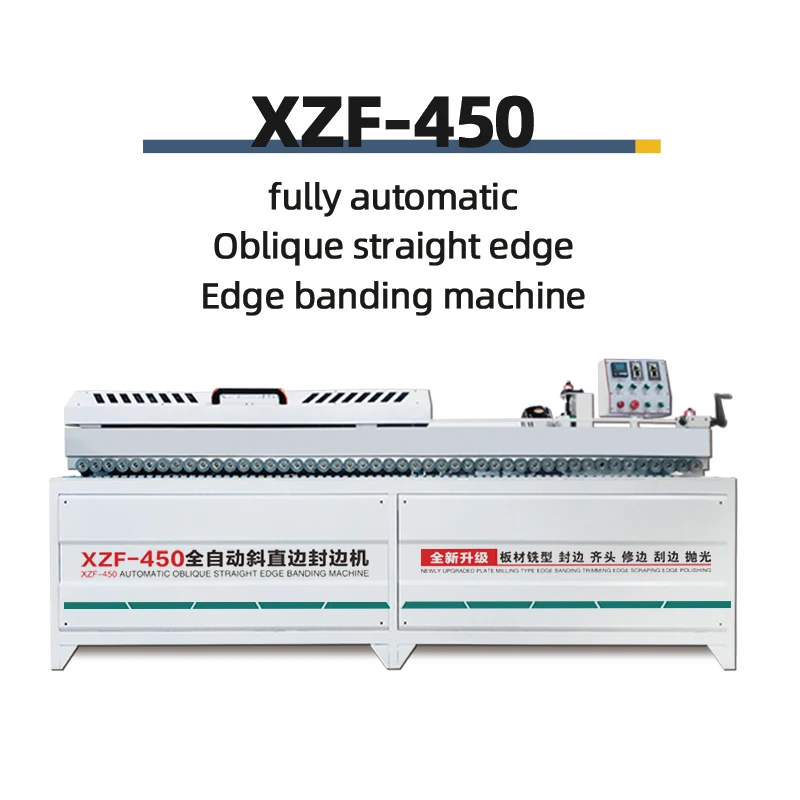
Having an automatic edge banding machine in stock shortens the gap between order placement and first panel run. For a cabinet maker replacing a failed edge bander mid-season, that availability can mean the difference between meeting a delivery deadline and losing a contract. The XZF-450 sits on the floor configured with its full seven-station sequence assembled and tested, so dispatch preparation involves final electrical verification rather than a ground-up build.
Multi-Angle Banding Without a Second Machine
Most entry-level edge banders handle only 90° straight edges, forcing workshops to outsource bevel work or invest in a secondary station. This model integrates 30°, 45°, and 60° angle banding capability within the same pass sequence [NEED_CITE: woodworking machinery multi-angle edge banding standards]. That means custom furniture pieces requiring chamfered or angled profiles can move through one machine, keeping lead times contained and floor space available for other operations.
Reading the Specifications Against Your Production Reality
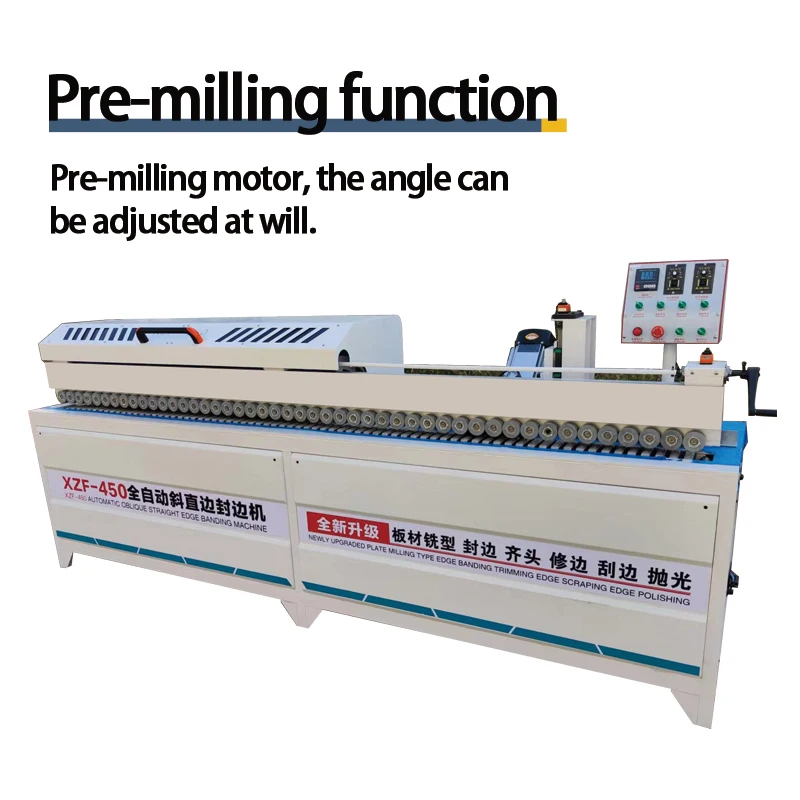
The 4 kW pre-milling motor removes a thin layer from the panel edge before the glue station, which matters when working with melamine or laminated boards where the substrate edge may carry micro-chips from the panel saw. Without pre-milling, those imperfections telegraph through the banding and become visible under angled light. The 0–12 m/min feed speed range gives operators room to slow down on thicker PVC strips that need longer glue open time and accelerate on thin veneer where dwell time is less critical.
A 4000 ml glue pot supports sustained runs without frequent refills, which keeps the operator focused on feed consistency rather than watching the glue level. The minimum sheet dimension of 30 cm length by 15 cm width defines the smallest offcut the feed chain can grip reliably — useful to know when planning nesting layouts on the panel saw [NEED_CITE: minimum workpiece dimensions for automatic feed systems in edge banding machinery]. The 0.5–0.7 MPa air pressure requirement is typical for pneumatic trimming and scraping actuators and should be cross-referenced against your existing compressor capacity.
The Cost of Overlooking Configuration Details
Workshops that select an edge bander on price alone often discover hidden expenses after arrival. A machine wired for the wrong frequency burns through contactors and motor windings at an accelerated rate. A control panel in an unfamiliar language slows operator training and invites parameter errors during setup. Panels that fail assembly because edge tolerance was never verified against the actual substrate represent wasted material, wasted time, and rework that erodes the margin the machine was supposed to protect [NEED_CITE: common causes of edge banding failure in furniture manufacturing].
Why Procurement Through This Channel Works
Stock visibility means you see what is physically available rather than waiting on a production slot. Each unit ships with voltage and plug type confirmed against the buyer’s electrical documentation before dispatch, not assumed from a regional guess. Factory test records on the buyer’s specified panel thickness and banding material accompany the shipment, providing a baseline for on-site commissioning. Spare parts lists and operation manuals are prepared in the agreed language so the first day of production is not spent translating error codes. The product family scales from entry-level to full-function configurations, meaning a workshop can add capacity later without switching suppliers or retraining operators on a different control architecture.
Documentation & Verification
- Factory test record captured on your specified panel thickness and banding material before dispatch
- Electrical schematic confirming voltage, frequency, and phase matched to your site supply
- Operation and maintenance manual supplied in your chosen language at shipment
- Spare parts list itemized for immediate procurement planning
- Packing photographs documenting machine condition prior to crating
Installation, Commissioning & Support
- Requires a dedicated 380V or 415V circuit rated for the 9.5 kW total load with appropriate isolation
- Compressed air line delivering 0.5–0.7 MPa must be routed to the machine’s inlet before first run
- 300 cm footprint length plus operator clearance defines minimum bay allocation on the shop floor
- Glue pot initial heat-up and temperature calibration should be completed before production panels enter the feed
- English-standard control panel can be configured to alternative languages before dispatch upon request
- Trimming and scraping station alignment verified at factory and re-checked during on-site commissioning
Before You Request a Quote
To move from inquiry to dispatch quickly, share your local voltage, frequency, and plug type along with a photo of your main distribution board nameplate. Specify the board materials and thickness range you process most often, plus the edge banding materials and widths in regular use. If your production includes angled profiles, confirm which bevel angles are required so the machine configuration matches your order book from day one.
Frequently Asked Questions
Q: What is the current stock status and dispatch lead time for the XZF-450?
A: The XZF-450 is listed as a stocked configuration, meaning the mechanical assembly and functional testing are complete. Dispatch preparation involves final electrical verification against your site specifications, packing, and customs documentation. Typical lead time from order confirmation to shipment gate is measured in days rather than weeks, though exact timing depends on the customization scope you request.
Q: Can voltage, frequency, and plug type be confirmed before I place the order?
A: Yes. Before any unit is released for shipment, we require documentation of your site’s electrical supply — typically a photo of the main panel nameplate showing voltage, frequency, and phase. The machine is then configured or verified to match, and the plug type is fitted accordingly from the EU, USA, AU, or UK options available.
Q: What edge banding materials and thicknesses does the XZF-450 handle from stock configuration?
A: The stock configuration supports PVC, ABS, melamine, and veneer edge banding in thicknesses from 0.3 mm to 3 mm. The 4 kW pre-milling station is particularly effective on melamine-faced boards where clean edge preparation directly affects the visibility of the glue line. For exotic materials outside this range, confirm compatibility during the inquiry stage.
Q: Is the control panel available in English or my local language out of the box?
A: Chinese and English are standard on the control panel. Spanish and other languages can be configured before dispatch upon request. Confirming your preferred language at the order stage ensures the operator interface is readable from the first day of production, avoiding commissioning delays caused by misinterpreted parameter labels.
Q: How is the machine packed, and what shipping options are available for single-unit orders?
A: The XZF-450 is packed in a wooden crate with protective wrapping around precision stations and the control panel. Single-unit orders are accommodated, and shipping can be arranged via less-than-container or full-container load depending on your logistics preference. Packing photographs are shared before dispatch so you can verify condition prior to the crate being sealed.