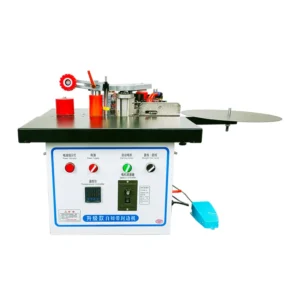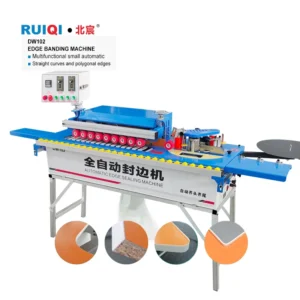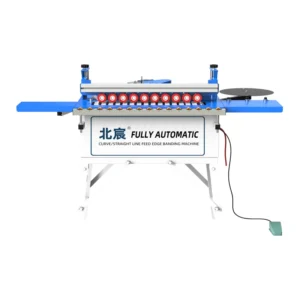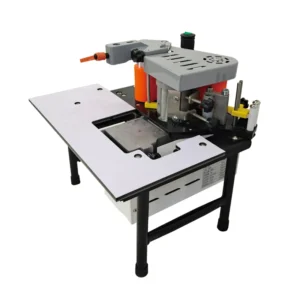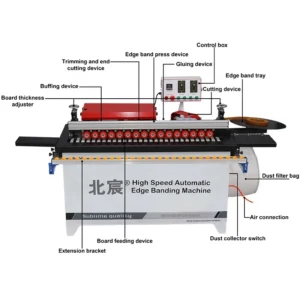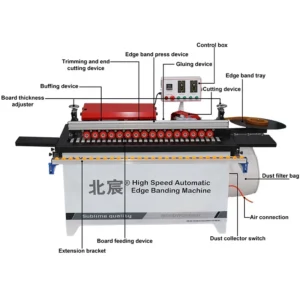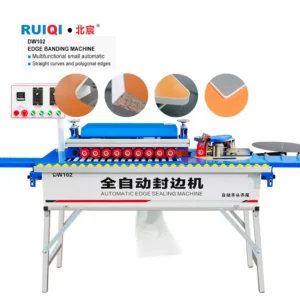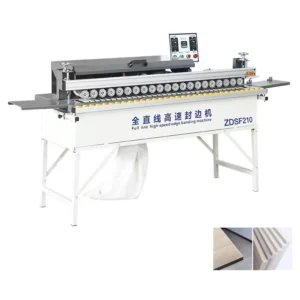
Description
Stocked Configuration — every ZDSF190 unit leaves the floor with voltage, frequency, and control language verified against your site conditions before the crate is sealed.
Technical Specifications
| Parameter | Value |
|---|---|
| Model | ZDSF190 |
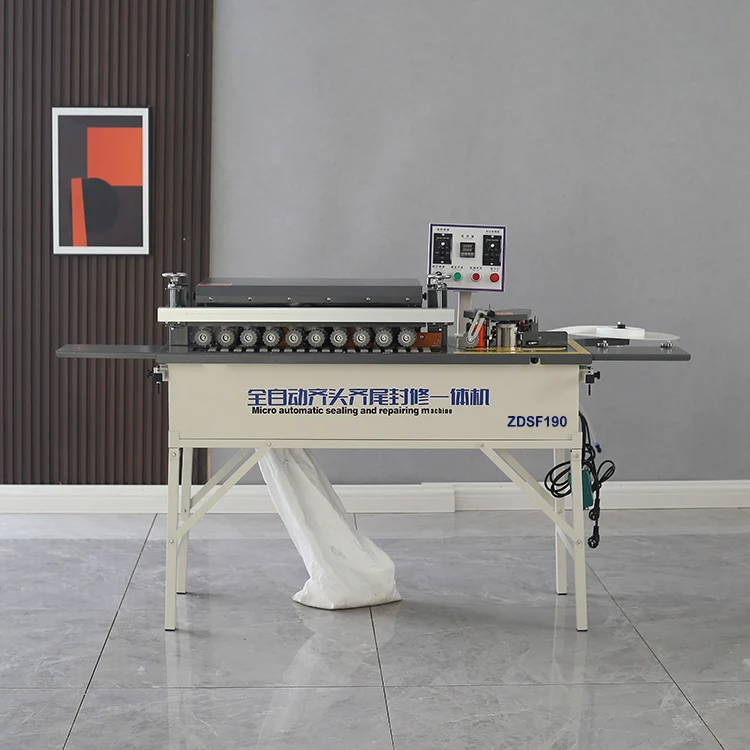
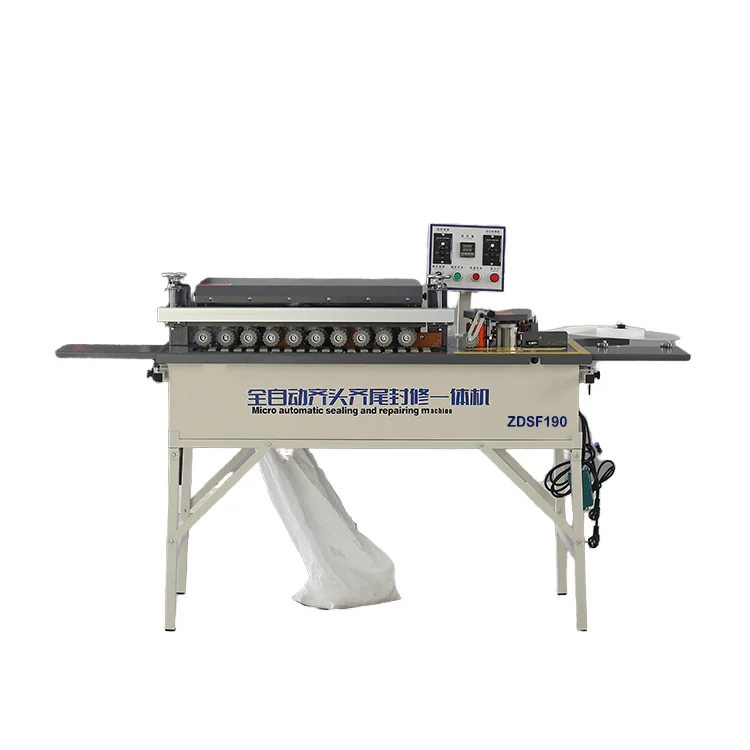
| Product Type | Miniature Fully Automatic Curved and Straight Dual-purpose Edge Banding Machine |
| Function | Automatic plate feeding, automatic belt breaking, double-sided gluing, upper and lower trimming and polishing, curved and straight edge banding |
| Edge Type | Both curved and straight lines |
| Voltage & Frequency | 220V / 50Hz |
| Rated Power | 4 kW |
| Suction Power | 1200 W |
| Heating Power | 800 W |
| Trimming Power | 800 W × 2 |
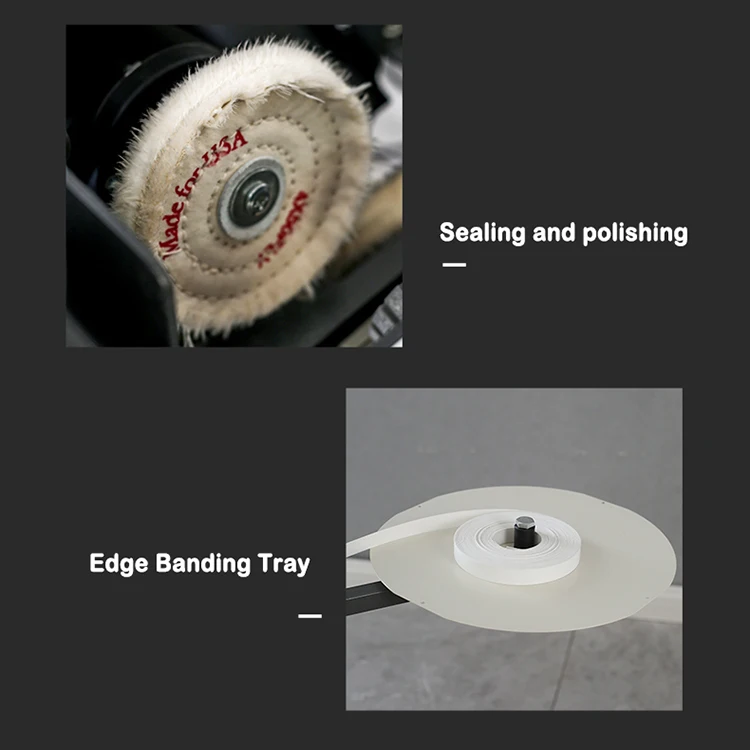
| Polishing Power | 180 W × 2 |
| Belt Power | 25 W |
| Transmission Power | 120 W |
| Conveyer Belt / Feed Speed | 0–14 m/min |
| Sheet Thickness Range | 10–50 mm |
| Strip Thickness Range | 0.5–2.5 mm |
| Glue Pot Capacity | 1000 ml |
| Rated Air Pressure | 0.4–0.6 MPa |
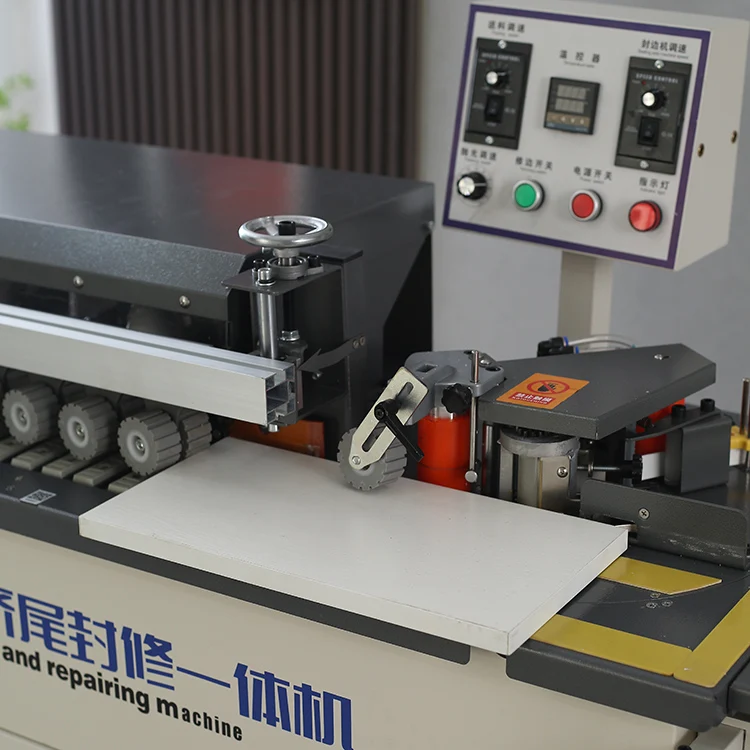
| Control System | Multi-function button operation |
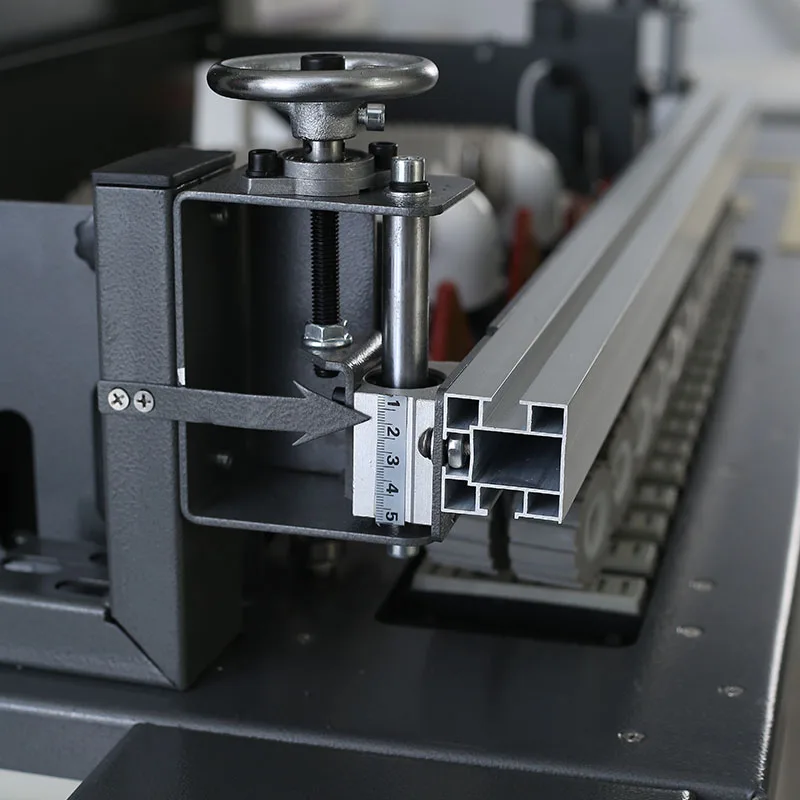
| Pressure Beam | Aluminum alloy, adjustable |
| Trimming Cutter | 4-edge arc-shaped alloy cutter head |
| Feed Mechanism | Double-row rubber pressure wheels, automatic plate feeding |
| Dust Collection | Large diameter surrounding vacuum, close fit |
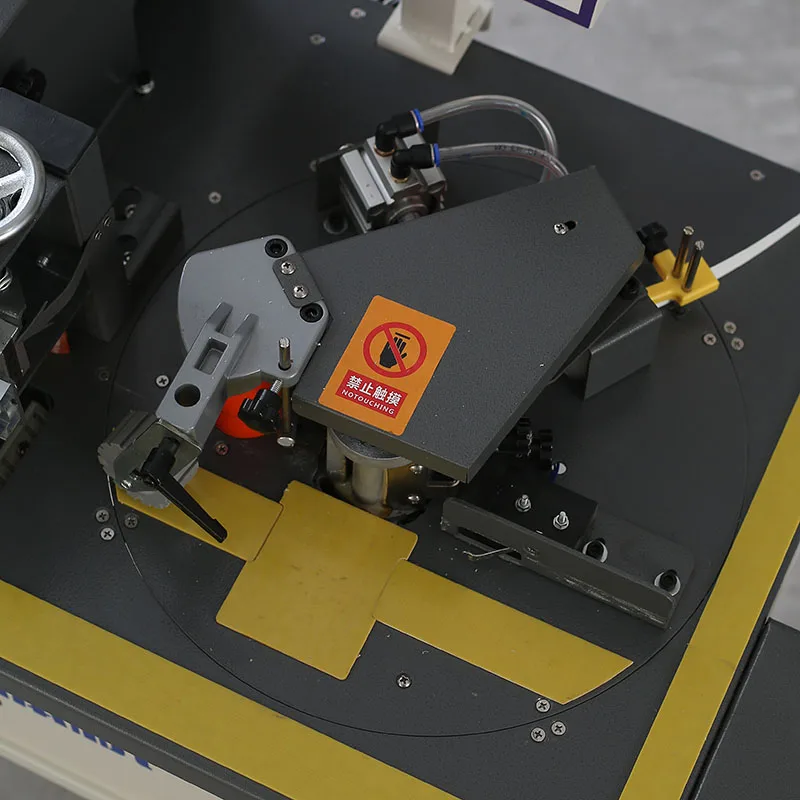
| Edge Strip Cutting | Pneumatically controlled |
| Polishing Device | Cross polishing up and down |
| Overall Dimensions | 1900 × 560 × 1300 mm |
| Net Weight | 120 kg |
Application Suitability
| Application | Material or Output |
|---|---|
| Custom cabinet door edging | MDF and plywood panels with PVC strip 0.5–2.5 mm |
| Small-batch curved furniture components | Solid wood panels and shaped MDF with veneer banding |
| Joinery startup straight-line production | Particleboard shelving and carcass parts with PVC edge |
| Prototype and sample-room work | Mixed substrates requiring frequent switch between curved and straight profiles |
Why Confirming Voltage Before Dispatch Matters More Than You Think
An automatic edge banding machine in stock is only useful if it actually runs when it arrives at your workshop. I have watched crates get opened on site only for the electrician to discover the motor winding does not match the local supply — the machine sits idle while a transformer is sourced or a rewinding shop is found. That downtime is not the seller’s problem once the bill of lading is issued. [NEED_CITE: voltage and frequency standards by export market]
Every ZDSF190 shipped from this store is confirmed at 220V/50Hz in writing before dispatch, matching the specification on the nameplate.
The pain usually shows up in markets where single-phase 220V and three-phase 380V coexist in the same industrial zone. A buyer assumes the smaller machine must be single-phase, the seller assumes the buyer will clarify, and neither side puts it on paper. The result is a 4 kW motor that either hums without starting or burns out within the first hour of operation.
What Ready Stock Actually Means for Your Workshop
When a joinery shop decides to move from hand-held trimming to a proper edge bander, the window between decision and installation is where competitors gain ground. The ZDSF190 is held as an automatic edge banding machine in stock so that the gap between order confirmation and dispatch is measured in days rather than production cycles. You send your panel samples and strip material specifications; the machine is tested against them before it leaves the floor.
Dual-Purpose Design Eliminates the Second Machine Purchase
Most small workshops buy a straight-line bander first, then realise six months later that curved cabinet fronts and rounded shelf edges require a second unit. The ZDSF190 rotates 180 degrees to switch between curved and straight modes, keeping both capabilities inside a single 1900 mm footprint. That matters when your floor space is rented by the square metre and every extra machine competes for the same bench area. [NEED_CITE: workshop layout planning for small furniture manufacturers]
Reading the Spec Sheet Against Real Panel Behaviour
The 10–50 mm sheet thickness range covers everything from thin MDF drawer bottoms to thick plywood shelving, but the critical detail is how the double-row rubber pressure wheels handle the transition. Thinner panels tend to flutter at higher feed speeds, which is why the variable 0–14 m/min conveyor lets you slow the feed for 10 mm stock without sacrificing the throughput on 25 mm carcass panels. The 1000 ml glue pot holds enough adhesive for sustained runs, reducing the number of mid-shift refills that introduce cold spots in the glue line.
The 4-edge arc-shaped alloy trimming cutter paired with cross polishing delivers a finished edge that does not require secondary hand-sanding — a step that often gets skipped in small shops and shows up as visible ridges on curved profiles. Dust collection through the large diameter surrounding vacuum keeps the trimming zone clear, which directly affects cutter life and edge consistency across a batch.
The Hidden Cost of Skipping the Configuration Check
Ordering an edge bander without confirming the air pressure requirement is a quiet failure. The ZDSF190 needs a stable 0.4–0.6 MPa supply for pneumatic strip cutting and pressure beam adjustment. Workshops running undersized compressors find the strip cut is ragged and the feed wheels slip intermittently, then blame the machine for what is actually a supply-side problem. [NEED_CITE: compressed air sizing for pneumatic woodworking equipment]
Language on the control panel is another detail that gets overlooked until the first operator stands in front of the multi-function buttons and cannot read the labels. Commissioning stalls, the installation visit runs over schedule, and the production manager is translating instructions from a phone screen while panels pile up on the infeed table.
Why Buyers Source This Model Through This Store
In-house manufacturing with patented cutting mechanisms means the trimming assembly on the ZDSF190 is not a third-party component rebranded under a different name — replacement cutters and wear parts trace back to the same production line. Voltage and language customisation is handled as a standard pre-dispatch step rather than a special request that adds weeks to the lead time. [NEED_CITE: OEM traceability requirements for woodworking machinery components]
Four-stage quality control with pre-shipment verification means each stocked unit is test-run on actual panel material before packing, and the test record ships with the machine. Engineer-led configuration is available within one business day: you provide your panel type, strip material, and daily volume, and the response includes a written confirmation that the ZDSF190 matches your requirements or a recommendation for a different model if it does not. Factory visits are welcomed for buyers who want to see the assembly floor and run their own samples before committing.
Documentation & Verification
- CE declaration of conformity covering the ZDSF190 electrical and mechanical safety requirements
- Factory test record showing edge banding results on your specified panel thickness and strip material
- Electrical schematic with confirmed 220V/50Hz wiring diagram for your local electrician
- Operation and maintenance manual written in your agreed language, not generic English-only
- Spare parts list with part numbers matching the trimmer, polishing pads, and feed wheels on your unit
Installation, Commissioning & Support
- Requires a dedicated 220V single-phase circuit rated above 4 kW to prevent voltage drop during heating cycles
- Compressed air line must deliver a stable 0.4–0.6 MPa at the machine inlet for reliable pneumatic strip cutting
- Overall footprint of 1900 × 560 mm allows placement against a standard workshop wall with rear access clearance
- First-run commissioning includes glue temperature calibration against your specific PVC or veneer strip material
- Double-row rubber pressure wheels inspected and tension-adjusted during pre-dispatch testing to match your panel thickness range
- Surrounding vacuum port sized for connection to a standard workshop dust extractor without additional ductwork modification
What to Include in Your Enquiry
To confirm the ZDSF190 fits your line, provide the panel substrates you run most often, the strip materials and thicknesses you plan to use, and your local voltage and frequency. If you are replacing a manual process, describe your current daily output so the feed speed range can be validated against your volume. Mention whether curved profiles are part of your regular product mix or an occasional requirement — that determines how often the 180-degree rotation will feature in your workflow.
Frequently Asked Questions
Q: Is this machine in stock and what is the dispatch lead time?
A: The ZDSF190 is held as an automatic edge banding machine in stock for fast dispatch. Once your voltage, language, and panel specifications are confirmed in writing, the unit is prepared and released for shipment. Lead time from confirmation to dispatch is typically measured in days, not production weeks, assuming the configuration matches an available unit.
Q: Does the 220V/50Hz configuration match my country’s electrical standard?
A: The standard stock configuration is 220V at 50Hz single-phase. Before dispatch, the electrical specification is reconfirmed in writing against your local supply. If your market uses a different voltage or 60Hz frequency, this must be stated at enquiry stage so the correct motor winding and heating element are verified or substituted.
Q: What is the maximum panel thickness and edge strip width this model handles?
A: The ZDSF190 accepts sheet thickness from 10 mm to 50 mm and strip thickness from 0.5 mm to 2.5 mm. These ranges cover standard MDF, plywood, and particleboard panels used in cabinet and furniture work. If your panels exceed 50 mm or you need strips thicker than 2.5 mm, a different model in the range may be more appropriate.
Q: Can I order a single unit, and what shipping options are available?
A: Single-unit orders are accepted and are typical for this store’s ready-stock angle. Shipping options are quoted at the enquiry stage based on your destination port or door address. The 120 kg net weight and compact dimensions allow standard LCL or FCL consolidation depending on your total order volume.
Q: What spare parts are included, and how do I reorder consumables?
A: Each shipment includes a spare parts list with part numbers for trimming cutters, polishing pads, and feed wheel components specific to your unit. Consumable reorders reference these same part numbers. The operation manual included with your machine identifies the recommended replacement intervals for each wear item.