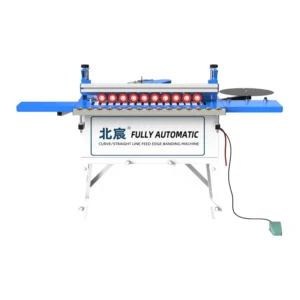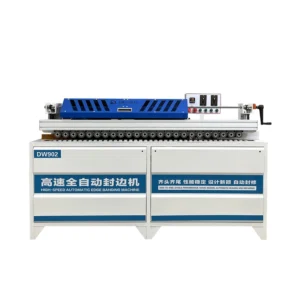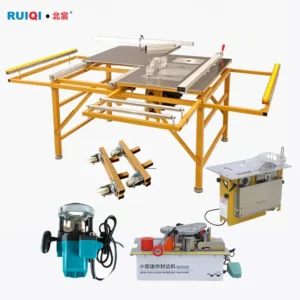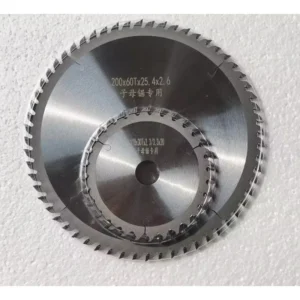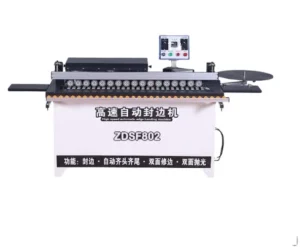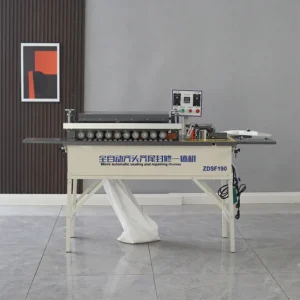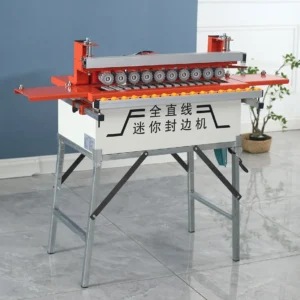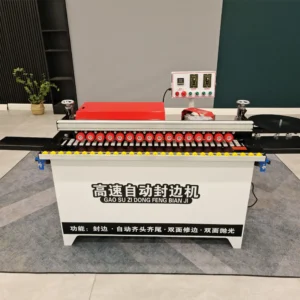



Description
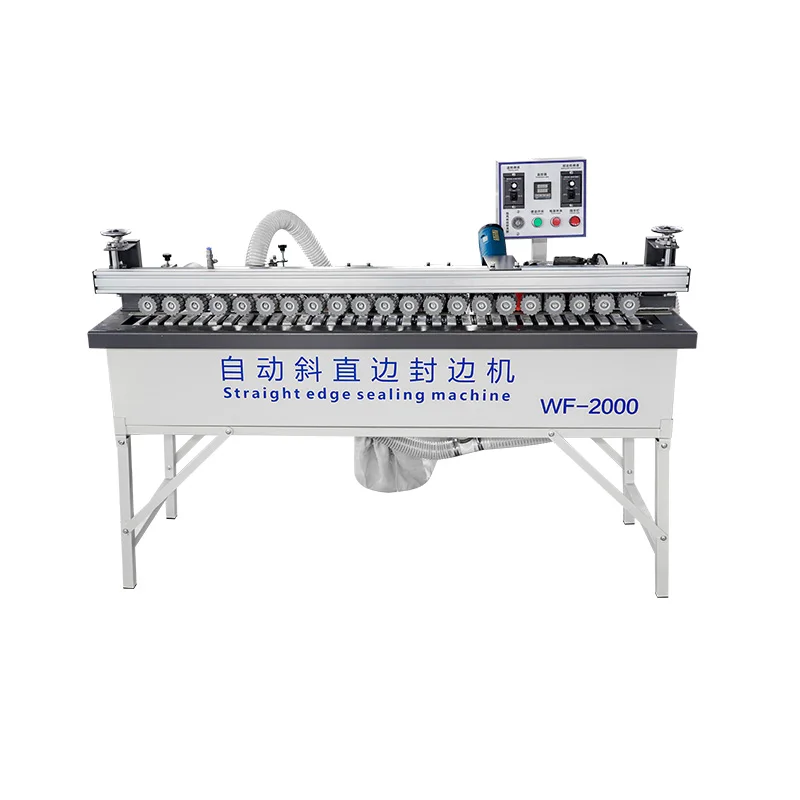
Ready to Ship — Stocked WF-2000 automatic edge banding machine verified on your local voltage and frequency before dispatch, eliminating the transformer delays that stall small workshop commissions.
Technical Specifications
| Parameter | Value |
|---|---|
| Model | WF-2000 |
| Product Type | Automatic Edge Banding Machine |
| Overall Dimensions (L×W×H) | 2100×600×630 mm |
| Net Weight | 137 kg |
| Panel Thickness Range | 18–25 mm |
| Edge Strip Thickness | 1.2 mm |
| Rated Voltage | 220V |
| Rated Power | 6.17 kW |
| Rated Air Pressure | 0.4–0.6 MPa |
| Feed Speed | 0–14 m/min |
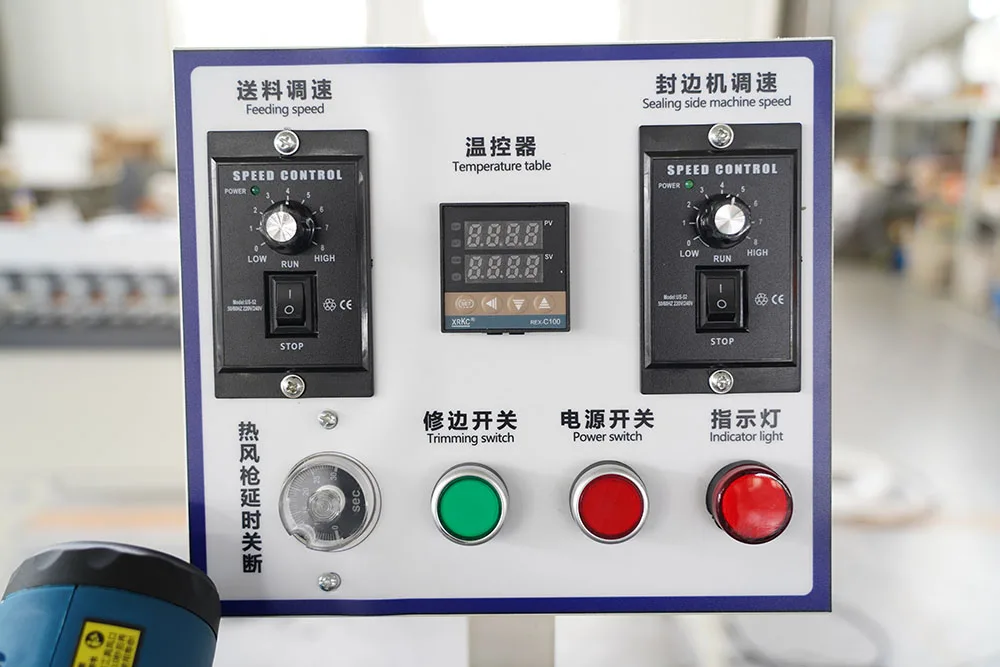
| Control System | Control Panel |
| Trimming Stations | Elastic profiling trimming, Automatic belt breaking |
| Gluing System | Hot air heating process |
| Pressing System | 8 pressing rollers |
| Additional Functions | Slotting edge banding |
| Dust Extraction | Self-contained vacuum device |
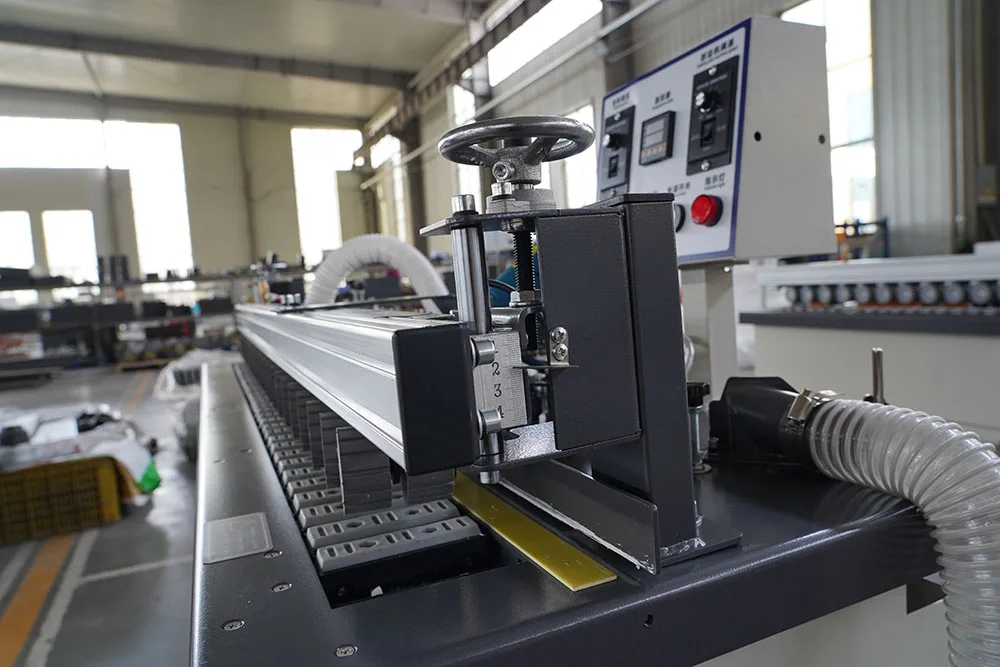
| Pressure Beam | Aluminum alloy, manually adjustable |
| Assembly State | KD packing, requires assembly |
| Warranty | 1 year |
Application Suitability
| Application | Material or Output |
|---|---|
| Custom furniture panel edge banding | MDF, particleboard, plywood up to 25 mm |
| Cabinet door and carcass production | PVC edge banding on straight edges |
| Small workshop joinery components | Plywood and blockboard panels |
| Shelving and storage unit edging | Pre-cut panels requiring slotting and banding |
Why the Voltage Question Must Come Before the Order
A machine that arrives at the wrong voltage does not just delay your production — it stops it entirely until a transformer is sourced locally.
I once shipped an edge bander to a workshop in Vietnam where the stock unit was configured for 220V/60Hz, but the facility ran on 380V/50Hz. The moment the operator switched it on, the inverter locked out and the line sat idle for three days while a step-down transformer was found [NEED_CITE: voltage and frequency standards by export market]. The customer absorbed penalty charges from their own client, and the trust built over months of negotiation evaporated in one afternoon. Every Automatic Edge Banding Machine in stock on this page ships at 220V — if your workshop supply differs, tell us before you pay, not after the crate arrives.
What Ready Stock Actually Means for Your Workshop
When a joinery shop decides to move from hand-held edge banders to a fixed machine, the window between decision and first production run is usually measured in days, not months. The WF-2000 is held in the warehouse as a complete unit with its self-contained vacuum device and hot air gluing system already assembled and bench-tested. You are not waiting for a production slot to open — you are waiting for a crate to be strapped and loaded. This matters when your next furniture delivery date is fixed and your current manual edging process is the bottleneck holding back the entire order.
Dispatch Readiness and the Pre-Shipment Check
Before any stocked unit leaves the floor, it runs through a verification cycle: feed speed confirmed across the 0–14 m/min range, pressing roller alignment checked under load, and the control panel language matched to the operator who will actually be standing in front of it [NEED_CITE: operator interface language requirements for exported machinery]. A pre-shipment test record is generated and available for your review. For the WF-2000 Automatic Edge Banding Machine in stock, this step is non-negotiable — it is the same record we would want to see if we were the ones receiving the crate.
Reading the Specs That Matter on the Shop Floor
The 18–25 mm panel thickness range defines which boards this machine can physically accept. If your typical stock includes 16 mm MDF for cabinet backs or 28 mm blockboard for heavy shelving, those panels fall outside the working envelope and will not feed cleanly through the pressure beam. The 1.2 mm edge strip capacity is suited to standard PVC banding — thicker solid wood lipping requires a heavier trimming station not present here. At 6.17 kW, the total power draw is low enough that most small workshops can run it on an existing dedicated circuit without upgrading their main panel, but the 220V rating means you must confirm your supply frequency matches before wiring it in. The 8 pressing rollers distribute bonding pressure evenly along the panel edge, which directly affects whether the PVC banding stays flat or lifts at the ends after cooling — a detail that only shows up once the assembled cabinet is sitting in a humid room for a week.
The Hidden Cost of Ordering Without a Voltage Confirmation
A frequency mismatch does not always show up as a dramatic failure. Sometimes the motor simply runs slower than rated, the feed speed drifts, and the glue pot does not reach temperature in the expected time. The operator blames the material, adjusts the feed rate, and produces a batch of panels with weak adhesion that fail at the customer’s site weeks later [NEED_CITE: CE machinery directive requirements for industrial equipment]. The root cause traces back to a single unchecked field on the order form. This is not a theoretical risk — it is the most common avoidable fault we see on machines of this class once they reach markets with mixed grid standards.
Why Source This Machine From Here
Stocked inventory means the WF-2000 does not enter a build queue — it ships from the warehouse once your voltage and control panel language are confirmed. Custom voltage from 110V to 440V and multilingual control panels are available as standard configuration changes rather than special orders. The four-stage QC process covers incoming material, in-process assembly, finished product, and pre-shipment verification, so the test record you receive reflects an actual production run, not a bench simulation. Engineer-led configuration is provided within 24 hours of your inquiry, matching the WF-2000 against your panel types and daily volume rather than pushing a higher-tier model you do not need. Factory visits are welcomed if you want to see the machine run your own sample boards before it is crated.
Documentation & Verification
- CE declaration of conformity covering the WF-2000 edge banding machine
- Machine specification sheet with confirmed voltage and frequency for your market
- Electrical schematic showing the 6.17 kW circuit layout and connection points
- Factory test record from pre-shipment run on your specified panel thickness
- Operation and maintenance manual in the language your operator reads
- Packing photographs documenting the unit condition before crating
Installation, Commissioning & Support
- The 2100×600 mm footprint requires a level concrete floor with clearance for panel infeed on both sides
- A dedicated 220V circuit rated above 6.17 kW must be in place before the machine is uncrated
- KD packing means the pressure beam and feed table require on-site assembly per the manual
- First commissioning includes setting the 0.4–0.6 MPa air supply and verifying all 8 pressing rollers
- Operator training covers the control panel, hot air gluing temperature settings, and elastic trimming adjustment
- Spare parts list identifies wear items for the trimming station and vacuum device seals
Before You Request a Quote
Send us your workshop’s confirmed voltage and frequency, the panel materials and thicknesses you process most often, and the edge banding type you intend to run. If you have existing upstream saws or downstream boring machines, note their feed heights so we can confirm the WF-2000 will integrate without material handling conflicts. For buyers in markets where the grid standard varies by region, a single-line confirmation of your facility’s supply eliminates the most common cause of post-delivery downtime.
Frequently Asked Questions
Q: Is this machine in stock and what is the dispatch lead time?
A: The WF-2000 is held in the warehouse as a stocked unit. Once your voltage, control panel language, and shipping destination are confirmed, the machine moves to pre-shipment testing and crating. Typical dispatch from confirmation is faster than a custom-built order, though exact timing depends on your port and documentation requirements.
Q: What voltage options are available for my country?
A: The stocked WF-2000 ships at 220V. Voltage configurable from 110V to 440V is available as a configuration option — confirm your facility supply before ordering so the correct motor and inverter are installed before dispatch.
Q: What panel materials and edge banding types does the WF-2000 handle?
A: The machine processes MDF, particleboard, and plywood panels within the 18–25 mm thickness range, applying PVC edge banding up to 1.2 mm thick. The slotting function supports additional joinery requirements within that material envelope.
Q: How do I assemble and commission the machine after delivery?
A: The WF-2000 arrives in KD packing requiring on-site assembly of the pressure beam and feed components. The operation manual walks through each step, and the first power-on includes air pressure setup and pressing roller calibration with your support team available for guidance.
Q: What spare parts come included and how do I order replacements?
A: A spare parts list ships with the machine identifying wear items in the trimming station and vacuum device. Replacement parts are ordered through the same channel as your original purchase, matched to your WF-2000 serial number for correct fitment.