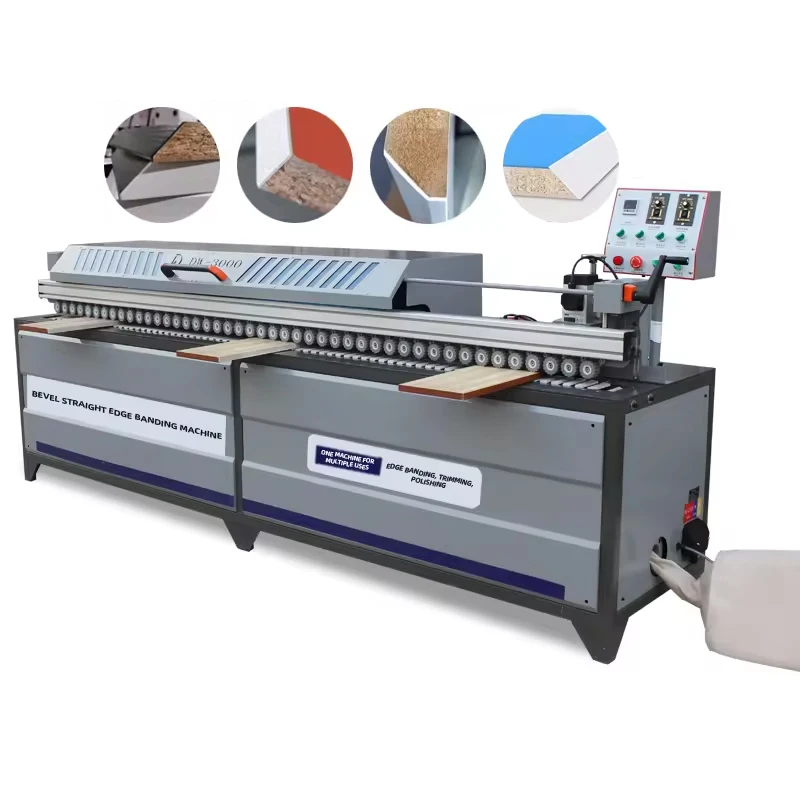
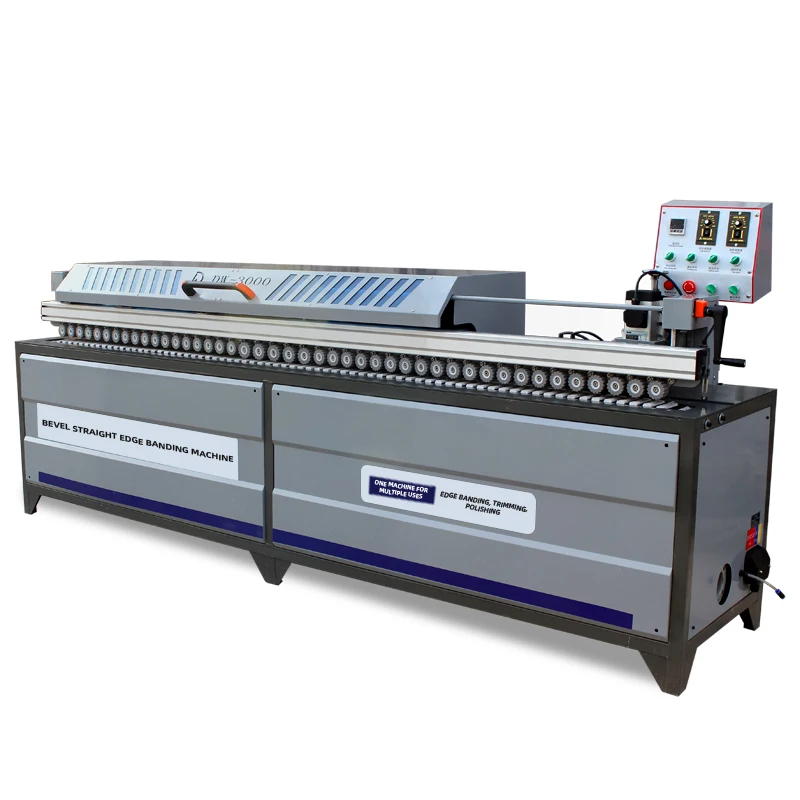
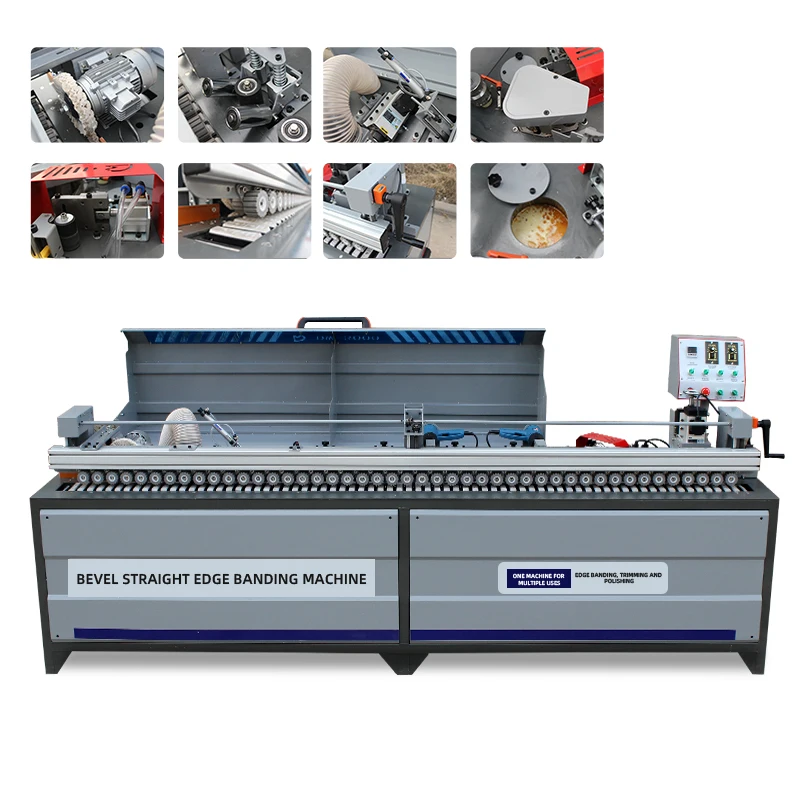
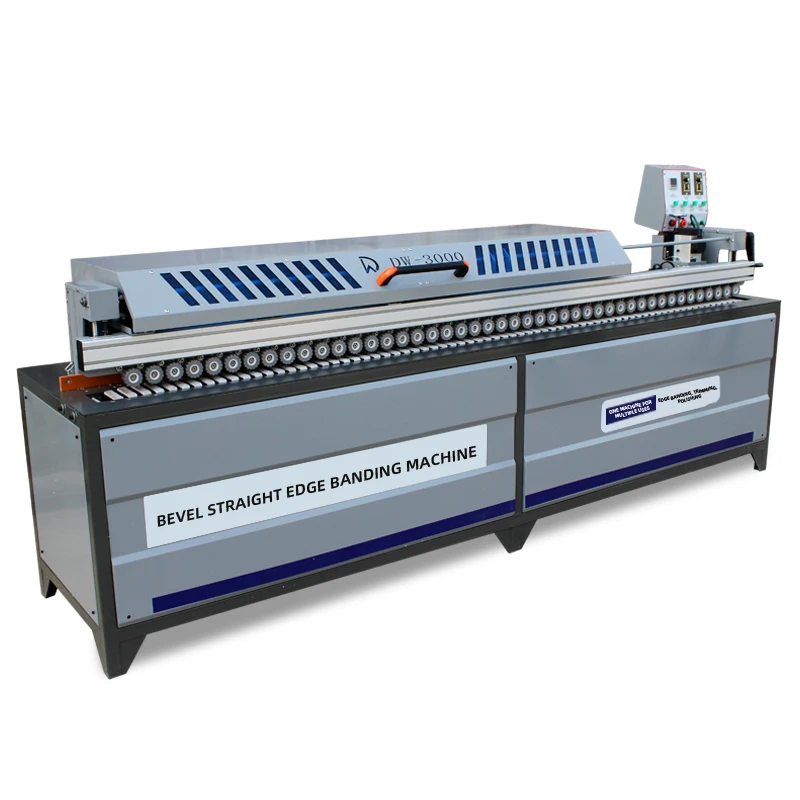
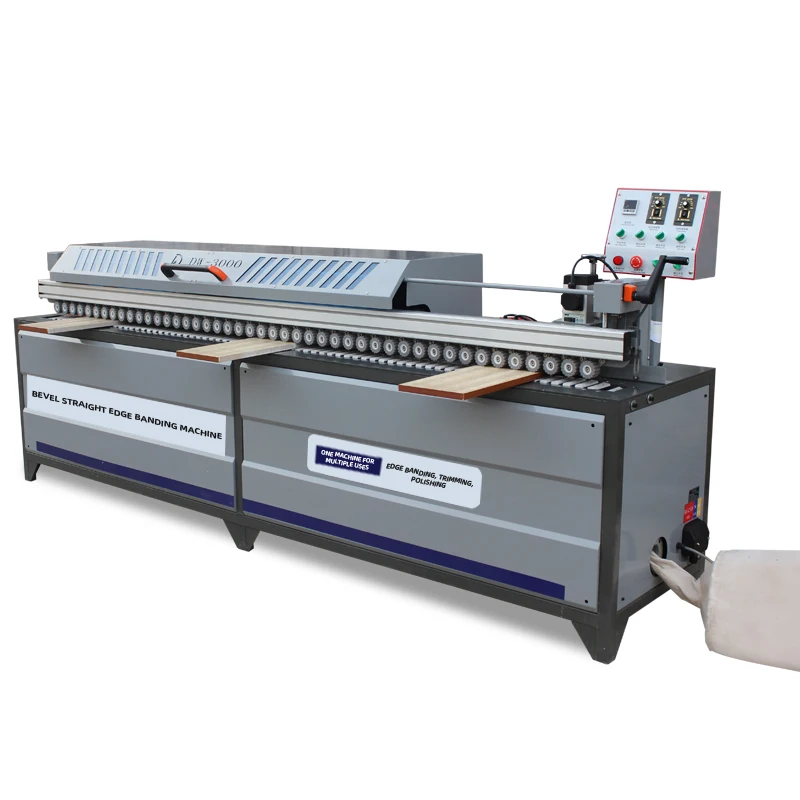
Description
Pre-Dispatch Verification — Every DW3000 order locks in your local voltage, plug type, and control panel language before the crate leaves our Ningjin facility, eliminating the on-site electrical surprises that stall commissioning.
Technical Specifications
| Parameter | Value |
|---|---|
| Model | DW3000 |
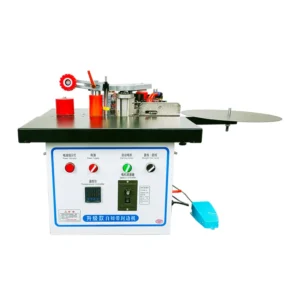
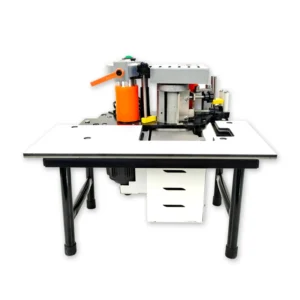
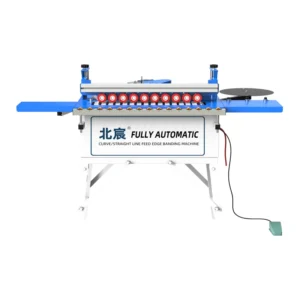
| Product Type | Fully Automatic 45 Degree Oblique Straight Edge Banding Machine |
| Total Power | 11 kW |
| Voltage & Frequency | 380V / 415V, 50Hz / 60Hz (basis to be confirmed per order) |
| Pre-milled Motor | 2.2 kW |
| Heating Power | 2.2 kW × 2 (double heat gun design) |
| Trimming Power | 2.2 kW × 2 (3 spindle trimming motors total) |
| Polishing Power | 0.4 kW × 2 |
| Vacuum Power | 550 W |
| Feed Speed | 0 – 12 m/min (160W motor) |
| Transmission Speed | 0 – 12 m/min (180W motor) |
| Edge Banding Height | 0 – 50 mm |
| Edge Banding Thickness | 0.3 – 3 mm |
| Minimum Panel Length | 30 cm |
| Minimum Panel Width | 15 cm |
| Oblique Pressure Wheels | 8 groups, 30° – 90° adjustable |
| Glue Pot Capacity | 4000 ml |
| Air Source Pressure | 0.5 – 0.7 MPa |
| Feeding System | Double cylinder feeding belt |
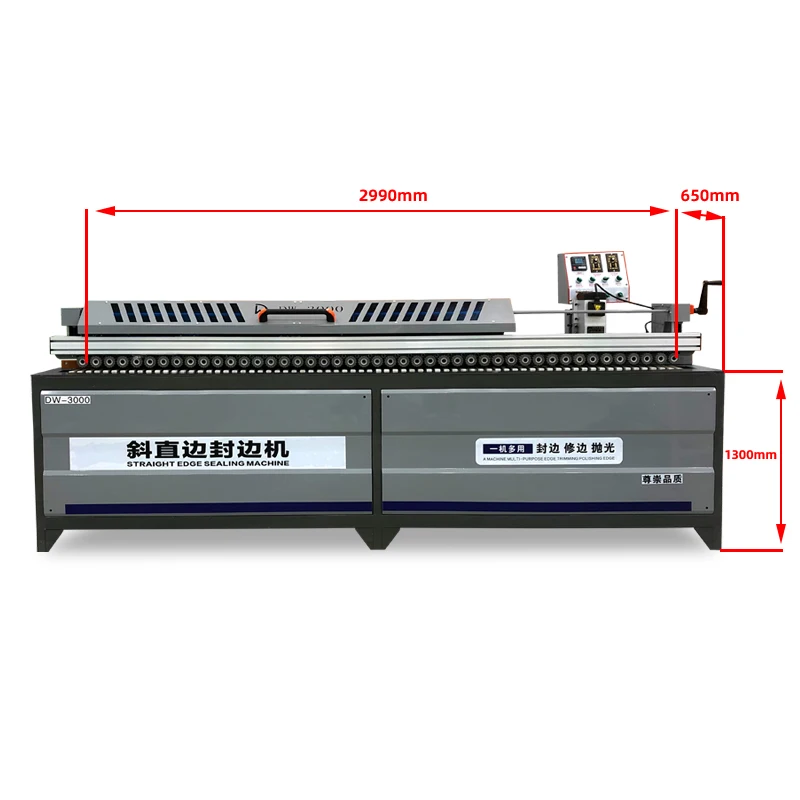
| Overall Dimensions (L×W×H) | 299 × 65 × 130 cm |
| Net Weight | 430 kg |
| Language Options | Chinese and English standard; Spanish, French or other languages customizable |
| Plug Options | EU, USA, AU, UK |
| Edge Band Slotting Device | Included, slotting height adjustable |
| Standards | ISO 9001 and CE (basis not stated in source — verify against manufacturer catalog) |
Application Suitability
| Application | Material or Output |
|---|---|
| Custom cabinet door production | MDF and particleboard with PVC or ABS edge banding on straight and 45° beveled edges |
| Plywood furniture panel finishing | Plywood panels with melamine or veneer edge banding up to 50 mm height |
| Small-batch joinery workshop runs | Solid wood panels requiring both straight trimming and oblique contour banding |
| Panel processing plant throughput | Mixed substrate batches transitioning between MDF, particleboard, and plywood without machine changeover |
Why the Voltage Question Should Come Before the Price on a 45 Degree Edge Banding Machine in Stock
A machine that cannot be powered on arrival is not in stock — it is a crate in your doorway.
I handled an order once where a buyer needed a 45-degree oblique edge bander urgently, and we shipped a standard 380V/50Hz unit from the floor. The destination workshop ran on 440V/60Hz. The machine sat idle for nearly three weeks while a variable-frequency drive was sourced and retrofitted locally. That delay cost the buyer production days and us credibility. Since then, no unit leaves the warehouse until voltage, frequency, and plug type are confirmed in writing [NEED_CITE: voltage and frequency standards by export market]. The DW3000 is configurable across common industrial voltage ranges, but the configuration has to happen before dispatch, not after arrival.
Dispatch Timing and Single-Unit Ordering Simplicity
Stocked DW3000 configurations are held ready for quick release, but "ready" means electrically and linguistically matched to your workshop. A single-unit order follows the same confirmation sequence as a production run: your exact voltage, plug standard, and control panel language are locked in before the machine is crated. This is what separates a genuine 45 degree edge banding machine in stock from a generic listing that ships a default configuration and leaves you to resolve the mismatch on-site.
Lead Time Reality for Workshop-Scale Buyers
When a joinery shop or small furniture factory needs to fill a production gap, the calendar matters more than the catalog. The DW3000 dispatch process prioritizes speed without skipping the pre-shipment verification stage. Your order moves from configuration confirmation through factory testing to crating in a compressed window, because the machine is already assembled — the delay variables are the electrical and language customization steps [NEED_CITE: typical commissioning delays from mismatched industrial voltage]. That is why the inquiry form asks for your local power supply details upfront rather than treating them as an afterthought.
Specification Decisions That Affect Downstream Assembly
The feed speed range of 0–12 m/min, driven by a dedicated 160W motor, gives operators fine control when transitioning between thin PVC banding on particleboard and thicker veneer strips on solid wood. Running too fast on veneer risks insufficient glue activation; the double heat gun design at 2.2 kW × 2 provides the thermal headroom to keep glue at working temperature even at higher feed rates. The eight groups of oblique pressure wheels, adjustable from 30° to 90°, distribute clamping force evenly along beveled edges — a single fixed-angle pressure zone would leave uneven adhesion on steeper bevels. Trimming relies on three spindle motors totaling 2.2 kW × 2 in cutting power, which handles the transition from rough trim to fine scrape without swapping tooling between panel thicknesses. The 4000 ml glue pot capacity supports sustained runs without mid-batch refills, which matters when you are banding a batch of cabinet sides and cannot afford a cold-start glue line mid-panel.
The Hidden Cost of Skipping Configuration Verification
Machines quoted on price alone, without confirming local voltage and frequency, arrive as dead weight. Operators face control panels in a language they cannot read, stalling the first test run while someone translates error codes. Entry-level banders pushed into production volumes they were never designed for develop feed belt slippage and inconsistent trim lines within the first few hundred panels. Tolerance claims that are not verified before shipment surface only when panels fail assembly and the glue line gaps become visible [NEED_CITE: common edge banding defects from unverified machine tolerance]. These are not warranty claims — they are commissioning failures that trace back to a missing question on the order form.
Why Source the DW3000 Through This Channel
In-house manufacturing with patented cutting mechanisms means the DW3000 is built, tested, and customized under one roof rather than assembled from third-party sub-assemblies. Voltage, language, and plug specification are handled as standard order parameters, not special requests requiring engineering change orders. Every unit goes through a four-stage quality control sequence covering incoming materials, in-process assembly, finished product inspection, and pre-shipment verification — your specific machine is tested on panels matching your thickness range before crating. The product family spans entry-level to full-function models, so a workshop that starts with the DW3000 can add capacity later without switching suppliers or retraining operators on a different control architecture. Factory visits are welcomed before or after order placement.
Documentation & Verification
- CE declaration of conformity referencing the DW3000 machine category
- Electrical schematic confirming your ordered voltage, frequency, and plug type
- Factory test record on your specified panel thickness and edge banding material before dispatch
- Operation and maintenance manual supplied in your agreed control panel language
- Spare parts list with part numbers matching the as-shipped configuration
- Packing photographs showing crate condition and component securing before shipment
Installation, Commissioning & Support
- Dedicated 3-phase circuit required; total draw of 11 kW means a minimum 25A breaker at 380V
- Floor space of 299 × 65 cm plus operator clearance; machine weight of 430 kg requires level concrete slab
- Air supply at 0.5–0.7 MPa must be clean and dry; inline filter recommended upstream of the machine
- First-run calibration covers feed belt tension, pressure wheel angle, and glue pot temperature for your specific banding material
- Glue pot and scraper surfaces require cleaning after each shift to prevent cured adhesive buildup on the 4000 ml pot
- Slotting device height adjustment verified during commissioning against your panel thickness range
What to Include With Your Inquiry
Send your local voltage and frequency, the plug standard your workshop uses, and the primary edge banding material and thickness you run most often. If your panels include 45-degree beveled edges, specify the bevel angle range so the pressure wheel setup can be pre-configured before dispatch. Note your preferred control panel language and whether you need documentation translated beyond standard Chinese and English.
Frequently Asked Questions
Q: Is the DW3000 in stock, and what is the dispatch lead time for a single unit?
A: DW3000 units are held in assembled, ready-to-configure condition. Once your voltage, frequency, plug type, and control panel language are confirmed, the unit goes through pre-shipment testing and crating. Dispatch timing depends on the customization scope, but single-unit orders are processed on the same priority track as production runs, without minimum order requirements.
Q: Can I confirm voltage, frequency, and plug type before placing the order?
A: Yes, this confirmation is mandatory before any DW3000 ships. You provide your local electrical specifications during inquiry, and we supply an electrical schematic matching your configuration for written approval. The machine is then wired to your confirmed voltage and fitted with your specified plug standard before the pre-shipment test.
Q: What control panel languages are available, and can I request English-only or Spanish?
A: Chinese and English are standard on all DW3000 units. Spanish, French, and other languages are available as customization options. Your preferred language is confirmed during the order process so the control panel interface and the operation manual match the language your operators will use daily.
Q: How is the machine packed, and what shipping options are available?
A: The DW3000 is crated with component securing and packing photographs are provided before the crate leaves the facility. Shipping options depend on your destination port and urgency. The 430 kg net weight and 299 × 65 × 130 cm dimensions determine container loading configuration, which is confirmed at the quotation stage.
Q: What spare parts are included, and how do I order replacements after delivery?
A: A spare parts list matching your as-shipped configuration is included with the machine documentation. Replacement parts are ordered by referencing the part numbers on that list. Consumables such as trimming blades and scraper elements should be reordered based on your production volume and material abrasiveness.