
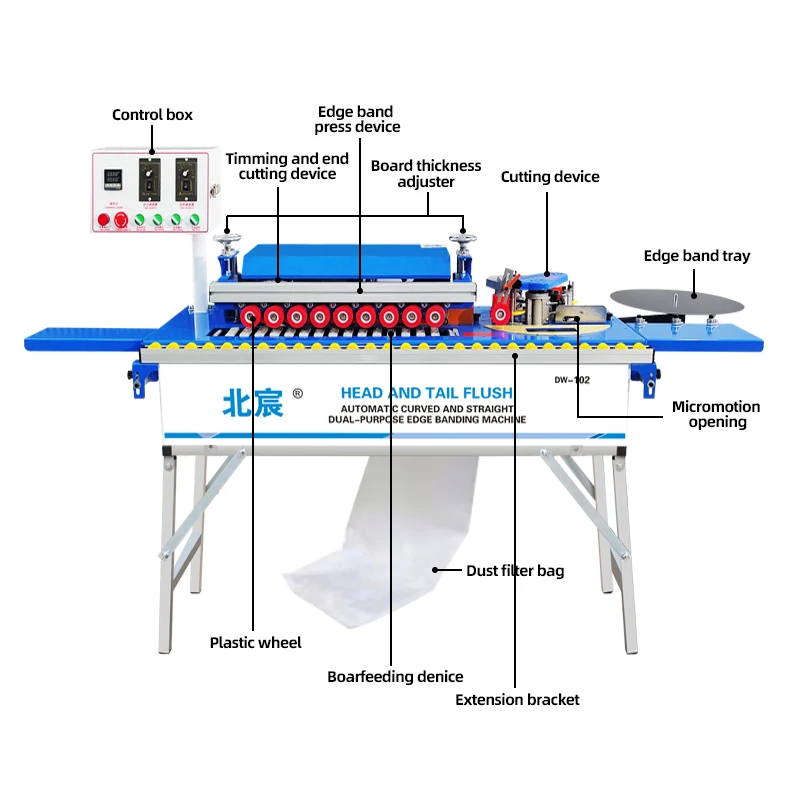
Description
Ready Stock Dispatch — Voltage, plug standard, and control panel language confirmed in writing before the DW102 leaves the factory, so it runs on day one.
Technical Specifications
| Parameter | Value |
|---|---|
| Model | DW102 |
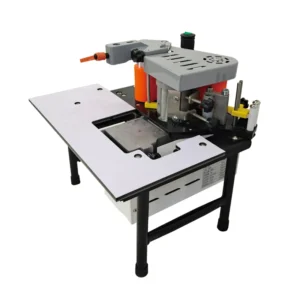
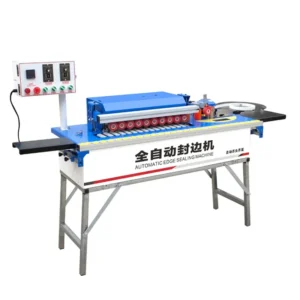
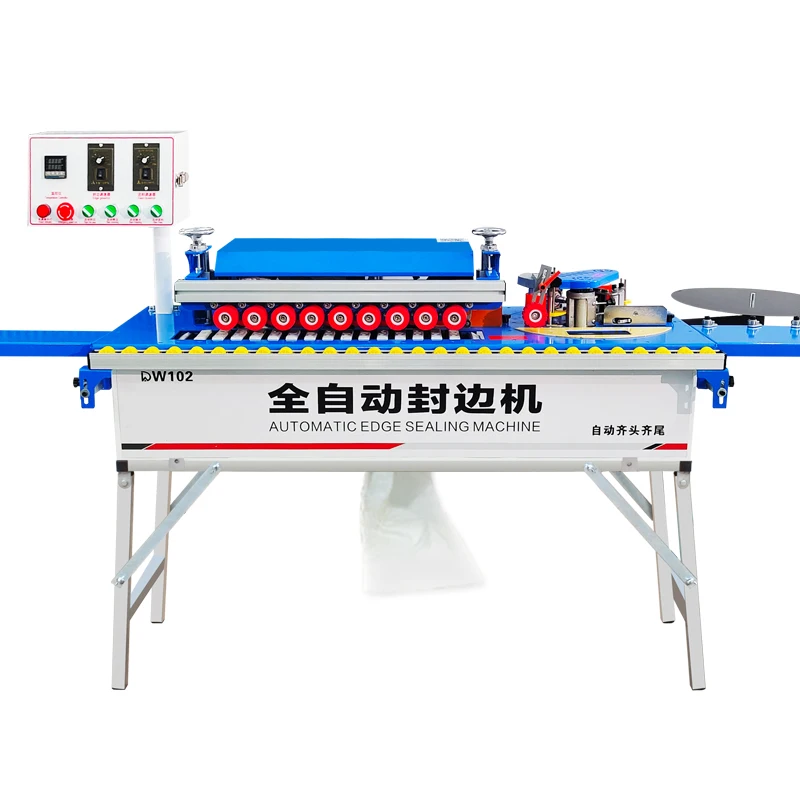
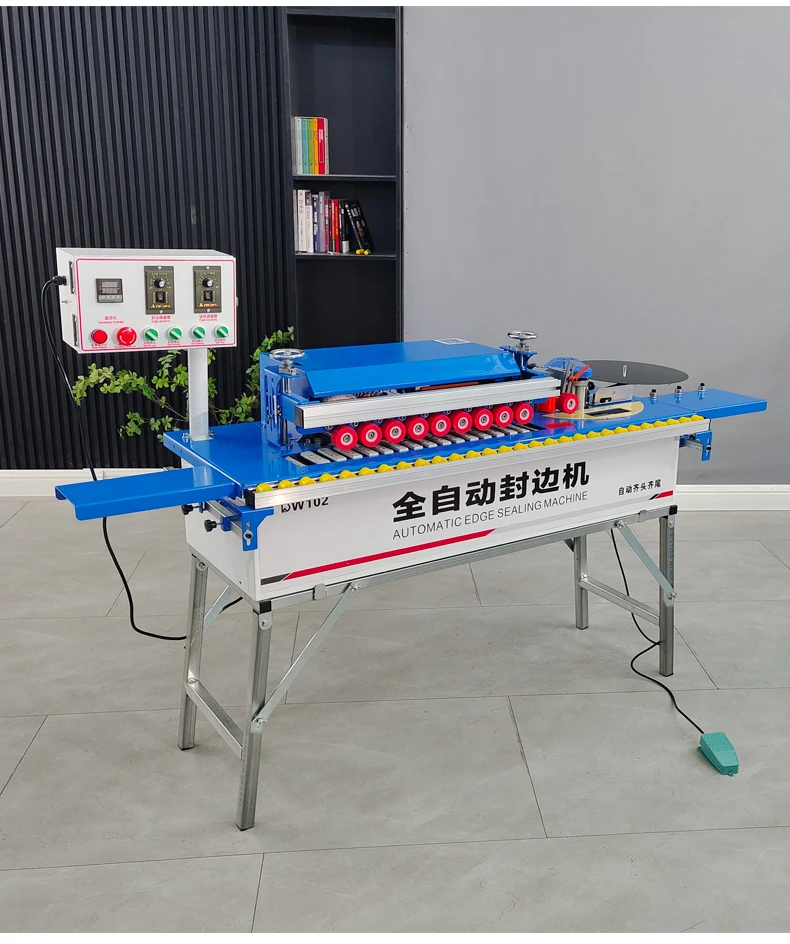
| Product Type | Automatic Edge Banding Machine |
| Total Power | 3800 W |
| Voltage & Frequency | 220 V / 380 V / customization (frequency to be confirmed) |
| Control System | PLC Controlled |
| Overall Dimensions (L × W × H) | 128 × 47 × 69 cm |
| Net Weight | 75 kg |
| Edge Banding Height Range | 0 – 50 mm |
| Edge Banding Thickness Range | 0.3 – 3 mm |
| Minimum Sheet Length | 25 cm |
| Minimum Sheet Width | 5 cm |
| Air Source Pressure | 0.5 – 0.8 MPa |
| Glue Pot Capacity | 1000 ml |
| Vacuum Power | 1200 W |
| Trimming Power | 650 W × 2 |
| Polishing Power | 180 W × 2 |
| Transmission Power | 60 W |
| Edge Feed Power | 20 W |
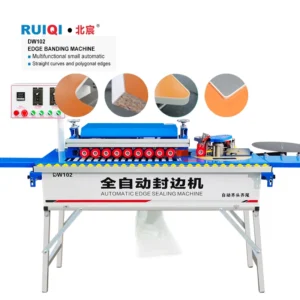
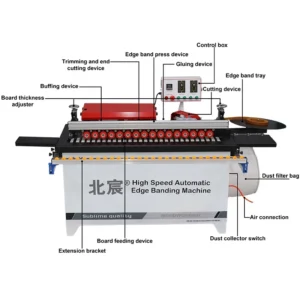
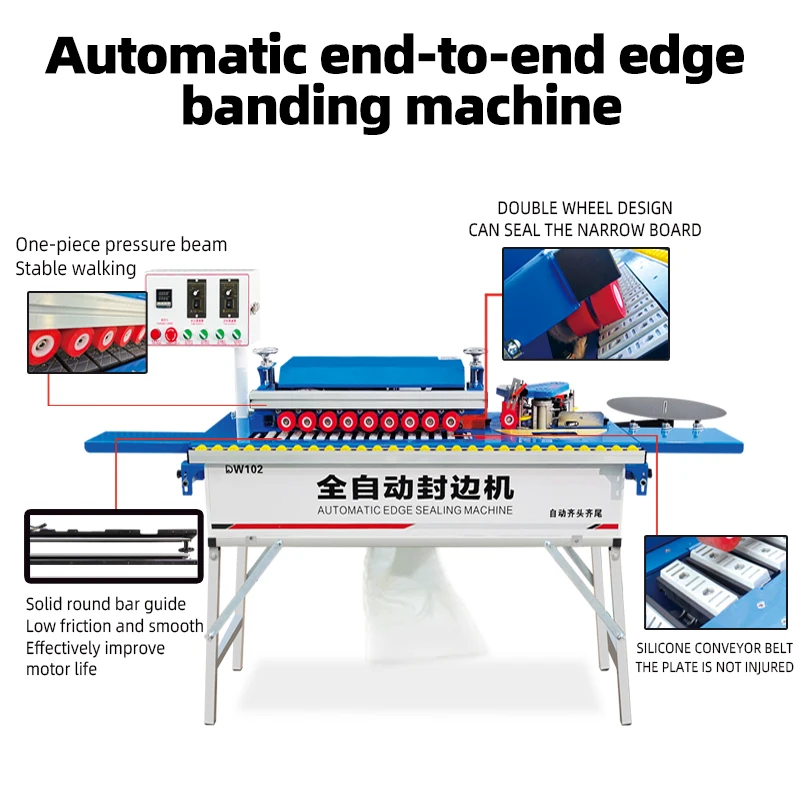
| Standard Features | Curved and straight edge banding, edge trimming, polishing, automatic head-and-tail cutting, vacuum hold-down |
| Language Options | Chinese, English (other languages customizable) |
| Plug Options | EU, USA, AU, UK |
| Assembly State | Fully assembled |
Application Suitability
| Application | Material or Output |
|---|---|
| Cabinet door and carcass edge finishing | MDF and particleboard with PVC or veneer banding |
| Plywood furniture panel edge banding | Plywood sheets, straight and curved profiles |
| Custom joinery small-batch production | Solid wood panels and blockboard up to 50 mm edge height |
| Polymer door panel finishing | Polymer composite panels with 0.3 – 3 mm edge material |
| Backup or secondary edge bander for panel plants | Mixed substrate runs on short lead times |
Why the Voltage Question Should Come Before the Price on an Edge Banding Machine in Stock
Confirming local voltage and frequency in writing before dispatch prevents a machine that sits idle for weeks.
I once helped ship an edge bander to a workshop in the Middle East. The order was placed, the crate went out, and three weeks later the customer called — the local supply was 380 V / 50 Hz, and the machine had been wired for a different configuration. They waited another three weeks for a step-down transformer before the unit could power on. That delay cost them more than any discount on the purchase price ever could. Now, the first thing I ask for is a photo of the workshop electrical cabinet nameplate. [NEED_CITE: voltage and frequency standards by export market]
How Ready Stock Shortens the Path from Order to First Cut
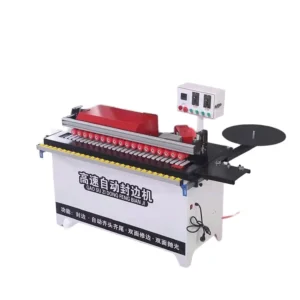
When a cabinet maker needs to add edge banding capability quickly, waiting for a custom production run is not an option. The DW102 is held as an edge banding machine in stock, meaning the physical unit is built, tested, and available for dispatch once pre-shipment verification is complete. Single-unit orders are accepted without minimum quantity requirements, which suits workshops adding one process step at a time.
Voltage selection — 220 V or 380 V — is confirmed against the buyer’s local grid before the unit is crated. Plug type (EU, USA, AU, or UK) is matched to the destination country’s socket standard so the machine connects directly to the workshop supply without adapters. This eliminates the most common cause of commissioning delays on imported woodworking equipment.
What Fast Dispatch Actually Covers Beyond the Crate
Shipping a machine quickly means little if it arrives without the paperwork and spare parts needed to run it. Every DW102 unit dispatched from stock includes a factory test record, an operation manual in the agreed language, a spare parts list, and packing photographs taken before the crate is sealed. [NEED_CITE: CE machinery directive requirements for industrial equipment]
The pre-shipment test covers the full sequence — gluing, trimming, head-and-tail cutting, and polishing — on a sample panel, so the buyer receives documentation showing the machine performed correctly before it left the factory floor. This matters especially when the buyer is ordering remotely and cannot attend a live inspection.
Reading the DW102 Specification Sheet for Workshop Fit
The 0 – 50 mm edge banding height range and 0.3 – 3 mm thickness range cover the PVC, melamine, and veneer banding materials commonly used in cabinet and furniture production. If most of your work involves 18 mm MDF with 0.4 mm PVC edging, the DW102 sits well within its capacity envelope rather than running at the upper limit.
The 1000 ml glue pot holds enough adhesive for sustained runs without frequent refills, while the 0.5 – 0.8 MPa air source requirement aligns with standard workshop compressor output. The 128 × 47 × 69 cm footprint means the unit fits against a wall or between existing machines in a small workshop, and the 75 kg net weight allows repositioning by two people when the layout needs to change.
Two 650 W trimming motors and two 180 W polishing motors handle the finishing sequence in a single pass, removing the need for separate manual trimming and buffing stations downstream.
The Hidden Cost of Skipping Pre-Shipment Verification
A machine that arrives with the wrong plug or an unreadable control panel does not produce revenue while it waits for a fix. I have seen workshops lose several weeks of scheduled production because the operator could not read the interface language, and a new control board with localized text had to be ordered and shipped separately. [NEED_CITE: impact of commissioning delays on small workshop cash flow]
Choosing an edge banding machine in stock without confirming electrical specifications and language settings upfront turns a fast delivery advantage into a slow resolution process. The cost is not the machine — it is the idle time, the missed delivery deadlines to your own customers, and the frustration that erodes trust in the supplier relationship.
What Buying from Stock Means in Practice Here
Voltage, frequency, and plug type are confirmed against your workshop’s electrical cabinet photo before the order is finalized — not after the machine is already built.
The control panel language is set to your operator’s requirement, whether English, Spanish, or another language, so commissioning starts with readable instructions on screen.
Pre-shipment testing is performed on a panel matching your specified thickness and edge material, and the test record ships with the machine.
Single-unit orders ship without a minimum order quantity requirement, which suits workshops adding one edge banding machine in stock to an existing line.
An engineer reviews your panel dimensions, substrate, and edge material before confirming the configuration, so the DW102 arrives matched to your actual production rather than a generic default.
Documentation & Verification
- CE declaration of conformity applicable to the DW102 edge banding machine
- Electrical schematic confirming your specified voltage and plug type
- Factory test record on your panel thickness and edge material before dispatch
- Operation and maintenance manual delivered in your agreed language
- Spare parts list with part numbers for reordering consumables
Installation, Commissioning & Support
- Requires a dedicated circuit matching the confirmed 220 V or 380 V supply and the 3800 W total power draw
- Arrives fully assembled — connect power and the 0.5 – 0.8 MPa air line, then run a test panel
- Compact 128 × 47 × 69 cm footprint fits standard workshop layouts without special foundation work
- PLC control panel configured in your chosen language before shipment for immediate operation
- Glue pot and trimming motors inspected during pre-shipment test; spare wear parts included
- Regular cleaning of the 1000 ml glue pot and polishing wheels maintains edge finish consistency
What We Need to Prepare Your DW102 Dispatch
To move quickly from inquiry to dispatch, share a photo of your workshop electrical cabinet nameplate showing voltage, frequency, and phase. Tell us the primary panel material, typical sheet dimensions, and the edge banding material and thickness you run most often. If the operator prefers a specific control panel language, specify that at inquiry stage so the PLC interface is configured before the unit ships.
Frequently Asked Questions
Q: Is the DW102 in stock now and what is the dispatch lead time?
A: The DW102 is held as ready stock, meaning the unit is fully assembled and available for pre-shipment testing once your voltage, plug type, and control panel language are confirmed. Dispatch timing depends on the confirmation steps rather than a production build cycle, which significantly shortens the path from order to shipment compared to made-to-order units.
Q: How do I confirm voltage, frequency, and plug type for my country before ordering?
A: Send a clear photo of your workshop electrical cabinet nameplate. Our engineer reads the rated voltage, frequency, and phase directly from the nameplate and confirms the matching configuration in writing before the DW102 is prepared for dispatch. Plug type — EU, USA, AU, or UK — is selected to match your local socket standard.
Q: Can I order a single unit, or is there a minimum order quantity?
A: Single-unit orders are accepted without any minimum order quantity. The DW102 is stocked to support workshops adding one edge banding capability at a time, and each unit receives the same pre-shipment testing and documentation regardless of order size.
Q: What languages are available on the control panel and can it be customized?
A: The PLC control panel is available in Chinese and English as standard, with additional languages configurable on request. The language setting is applied before dispatch so the operator can read all menus and alerts from the first power-on, avoiding commissioning stalls caused by an unfamiliar interface.
Q: What documentation and spare parts ship with the machine?
A: Every DW102 ships with a factory test record, an operation and maintenance manual in the agreed language, an electrical schematic matching the confirmed voltage, a spare parts list with reorder numbers, and packing photographs taken before crating. Customs documentation support is also provided to smooth the import process.