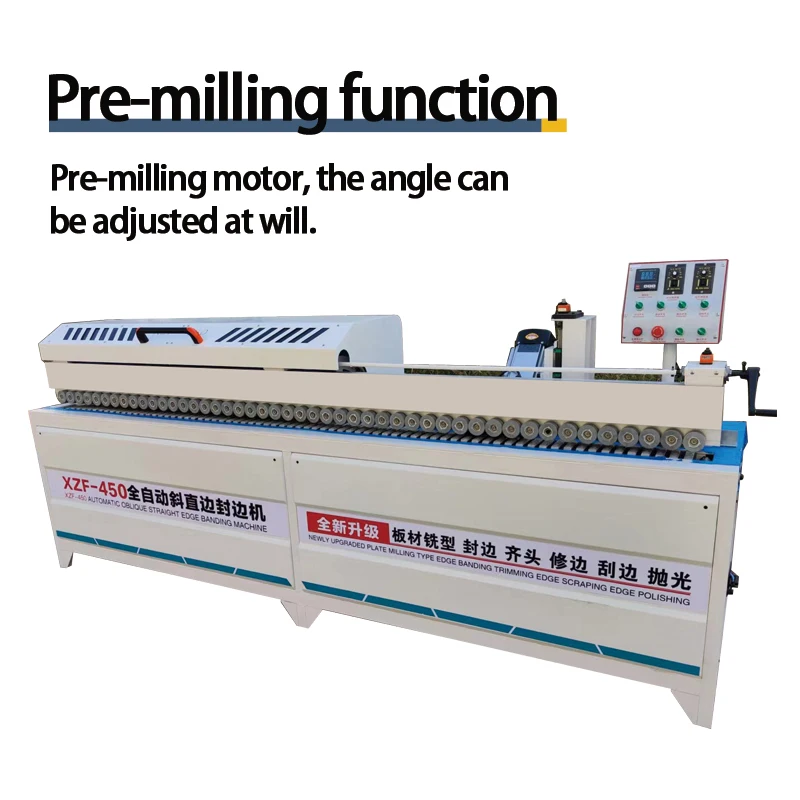
Description
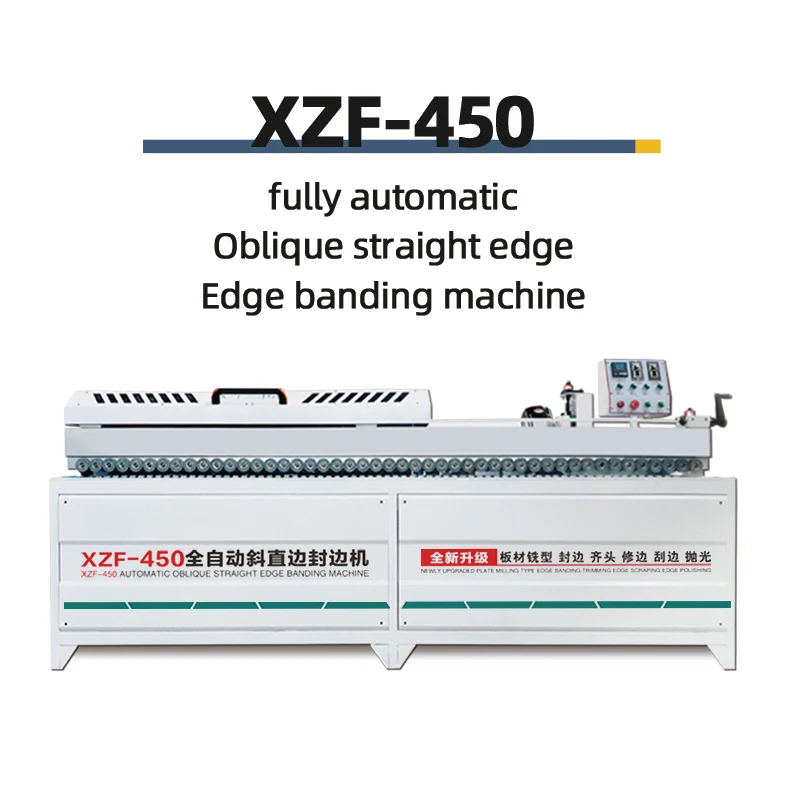
Stocked and verified — every XZF-450 automatic edge banding machine is voltage-confirmed and tested with your panel material before dispatch, eliminating the arrival-day surprises that halt production.
Technical Specifications
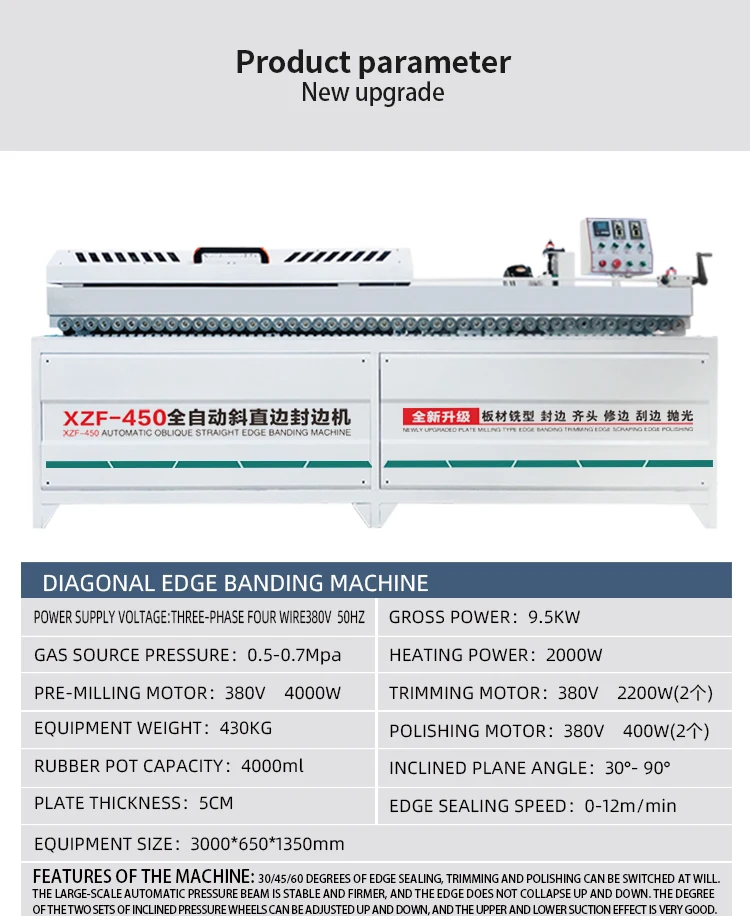
| Parameter | Value |
|---|---|
| Model | XZF-450 |
| Product Type | Automatic Edge Banding Machine |
| Total Power | 9.5 kW |
| Voltage Options | 380V / 415V (factory confirmed before dispatch) |
| Pre-milling Motor | 4 kW |
| Trimming Power | 2.2 kW × 2 |
| Vacuum Power | 550 W |
| Polishing Power | 0.4 kW × 2 |
| Feed Speed | 0–12 m/min (adjustable) |
| Edge Banding Thickness | 0.3–3 mm |
| Edge Banding Height | 0–50 mm |
| Minimum Sheet Length | 300 mm |
| Minimum Sheet Width | 150 mm |
| Glue Pot Capacity | 4000 ml |
| Air Source Pressure | 0.5–0.7 MPa |
| Overall Dimensions | 3000 × 650 × 1350 mm |
| Net Weight | 430 kg |
| Control Panel Language | Chinese / English standard; other languages configurable |
| Plug Options | EU / USA / AU / UK |
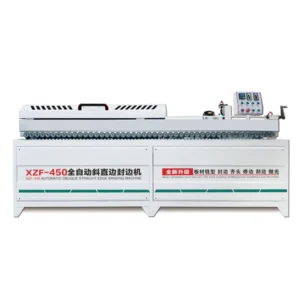
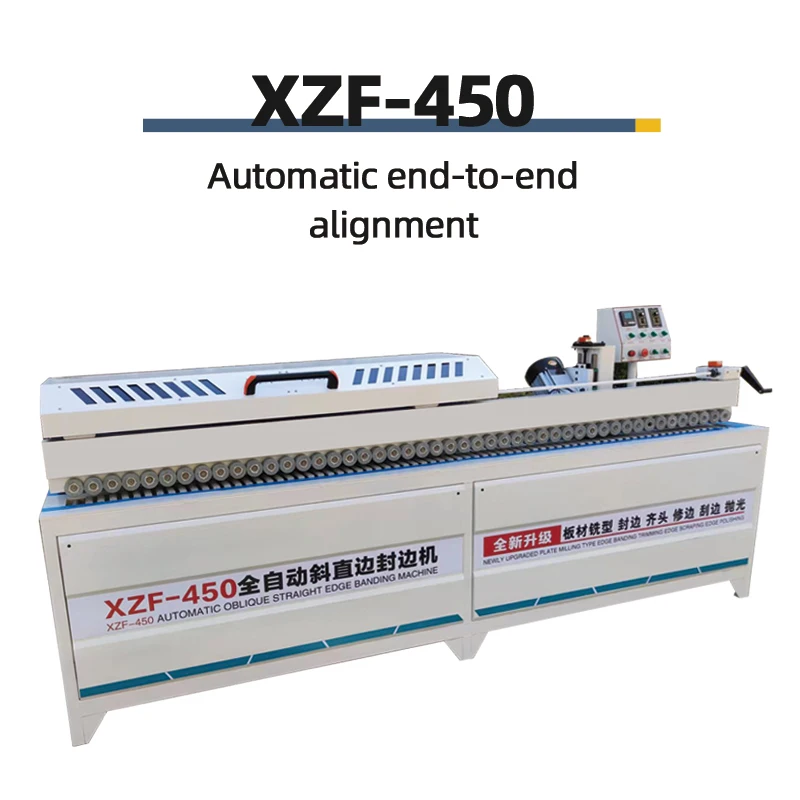
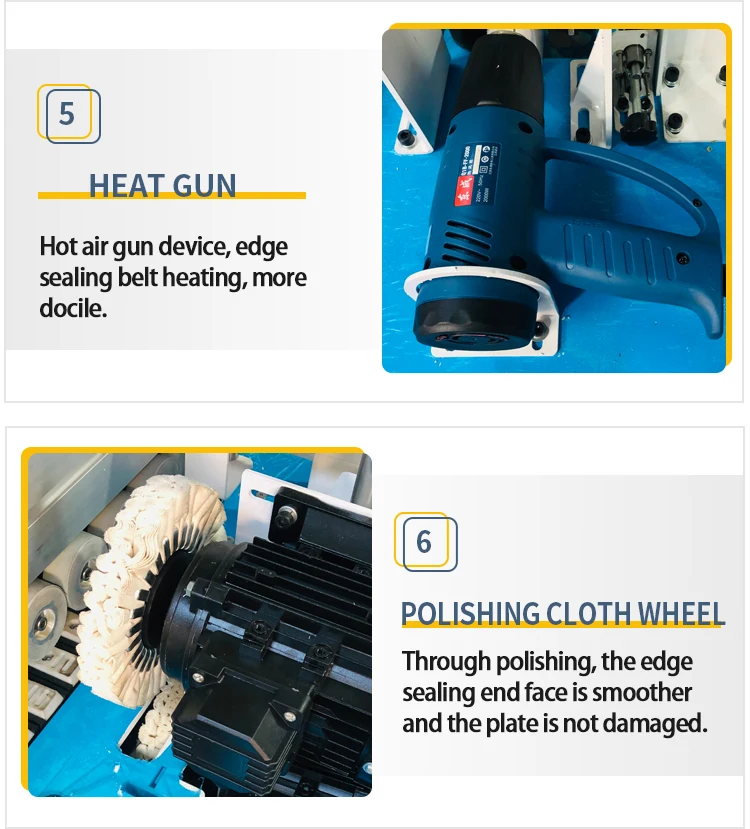
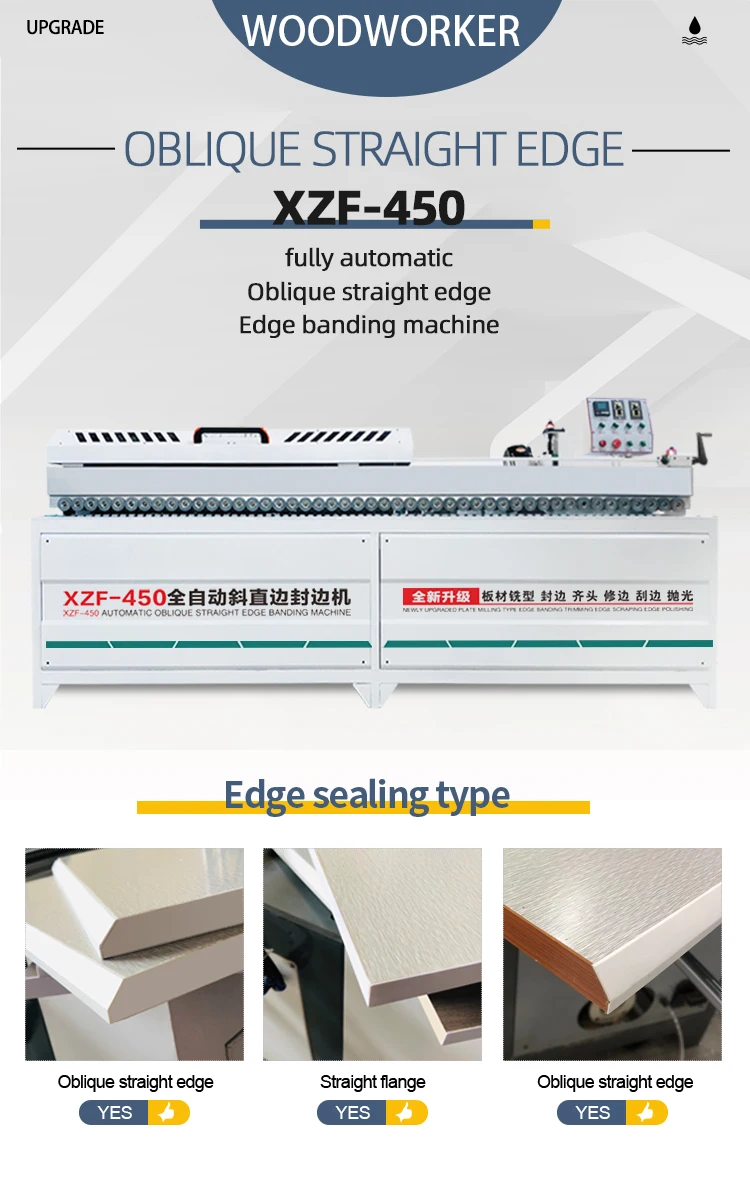
| Standard Functions | Pre-milling, 30°/45°/60° edge banding, end trimming, rough/fine trimming, scraping, polishing, high-power vacuuming |
Application Suitability
| Application | Material or Output |
|---|---|
| Cabinet door and carcass edge finishing | MDF, melamine-faced board, particleboard |
| Plywood and blockboard furniture panels | Plywood, blockboard with PVC or veneer edge banding |
| Angled edge profiles for custom joinery | 30°, 45°, and 60° bevel edges on solid wood and composite panels |
| Polymer door and panel edging | Polymer sheets on MDF or particleboard substrate |
| Medium-volume workshop production runs | Mixed panel batches requiring quick changeover between material types |
Why the Voltage Question Must Come Before the Price
An edge banding machine in stock means nothing if it arrives wired for the wrong grid.
I learned this the hard way when a 380V cabinet was shipped to a 440V site in the Middle East. The variable frequency drive burned on first power-up, and the customer sat idle for two weeks waiting for replacement parts. That unit had been quoted, paid for, and dispatched — but the voltage confirmation step was skipped. Since then, I treat the electrical schematic and voltage sign-off as non-negotiable before any edge banding machine in stock leaves the factory [NEED_CITE: voltage and frequency standards by export market].
The XZF-450 supports 380V and 415V configurations, but local grids can drift, and some regions run frequencies outside the standard 50/60 Hz assumption. Confirming your exact supply before the machine is wired prevents costly rewinds and unplanned downtime.
Dispatch Without the Waiting Game
Most workshops ordering an edge banding machine in stock want it running within days, not months. The XZF-450 is held in ready-to-ship inventory, meaning the lead time is governed by sea freight or air routing rather than a production queue. For buyers testing a single unit before committing to a full line, this removes the penalty of small orders — you get the same machine, the same documentation, and the same pre-shipment test whether you order one or ten.
Ordering One Unit Should Not Mean Compromising
Some suppliers reserve full configuration support for large batches. Here, a single-unit order still receives voltage confirmation, plug fitting to your local standard (EU, USA, AU, or UK), and a control panel set to a language your operator can actually read. These are not extras; they are baseline steps that prevent the commissioning stalls I have seen cost small workshops an entire production week [NEED_CITE: CE machinery directive requirements for industrial equipment].
Reading the Numbers That Matter
The 4 kW pre-milling motor is significant because it determines how cleanly the substrate is prepared before glue application. A weak pre-mill leaves tear-out on melamine and particleboard, forcing the operator to slow the feed speed or accept visible edge defects. The XZF-450’s 4 kW unit handles standard board densities at the full 12 m/min feed range without requiring the operator to back off.
Edge banding thickness coverage from 0.3 mm to 3 mm means the same machine runs thin PVC for cabinet interiors and thicker veneer or ABS for visible furniture faces. Shops that try to push 3 mm banding through a machine rated only for 1 mm will see poor adhesion and trimming chatter — the XZF-450 is built to handle the full span without swapping tooling.
The 4000 ml glue pot capacity supports sustained runs without frequent refills, which matters when a batch of 200 panels is mid-flow and stopping to top up breaks the thermal stability of the glue. Consistent pot temperature across the run translates directly to consistent bond strength.
The Hidden Cost of Skipping Configuration Checks
When a buyer purchases a machine piecemeal — perhaps an edge bander from one supplier and a panel saw from another — feed heights and throughput rates often mismatch. Panels exit the saw at a speed the edge bander cannot match, creating a bottleneck that shows up only after both machines are installed. Confirming the XZF-450’s 0–12 m/min feed range against your upstream cutting output avoids this kind of silent incompatibility [NEED_CITE: production line throughput matching in panel processing].
Similarly, specifying a machine without verifying air source pressure leads to inconsistent scraping and polishing. The XZF-450 requires 0.5–0.7 MPa; workshops running undersized compressors will see uneven finish quality that operators mistake for a machine defect.
Why Buyers Source This Model Here
The XZF-450 sits in a product family that scales from entry-level to full-function pre-milling configurations, so a workshop can add capacity later without changing suppliers or retraining operators on a different control platform.
Voltage and language customization are treated as standard order steps, not special requests — every unit ships with a confirmed electrical schematic and a manual in the agreed language.
Pre-shipment testing is documented with photographs of your specific panel material running through the machine, so you see the edge quality before it leaves the factory floor.
The four-stage quality check covers incoming components through final packing verification, catching tolerance drift before it reaches your dock.
An engineer reviews your factory scale and processing requirement before issuing a formal quotation, reducing the chance of specifying a machine that is oversized for your current volume or undersized for your growth plans.
Documentation & Verification
- Electrical schematic and voltage confirmation sheet matching your site supply
- Factory test record showing edge quality on your specified panel material
- Operation and maintenance manual in your chosen language
- Spare parts list with part numbers for immediate reordering
- Packing photographs documenting crate condition before collection
- CE declaration of conformity for customs clearance in applicable markets
Installation, Commissioning & Support
- Requires a dedicated 380V/415V circuit rated for the 9.5 kW total draw; confirm breaker sizing with your electrician before arrival
- Overall footprint of 3000 × 650 mm means plan for operator clearance on both feed and exit sides
- Air line must deliver stable 0.5–0.7 MPa; install a regulator and moisture trap upstream of the machine
- First run should use scrap panels at low feed speed to verify glue temperature and trimming alignment before committing production stock
- Control panel language set to your operator’s preference before dispatch; reconfiguration guidance included in the manual
- Spare wear parts shipped with the unit cover initial months of operation; full spares list provided for ongoing procurement
What to Share Before Requesting a Quote
To move quickly, send your panel material types and typical thickness range, the voltage and frequency at your facility, and whether your operators need a control panel in a language beyond Chinese or English. If you are integrating the XZF-450 into an existing line, share your upstream saw output rate so the feed speed can be matched. Let us know if you want to send sample panels for a pre-shipment test run — this step adds a few days but eliminates guesswork on edge quality.
Frequently Asked Questions
Q: What is the dispatch lead time for a stocked XZF-450, and can shipping options be quoted upfront?
A: Stocked units are prepared for dispatch once voltage, plug type, and language are confirmed. Transit time depends on your port and chosen freight method. Shipping options and estimated arrival dates are quoted alongside the machine price so you can plan installation before the crate leaves the factory.
Q: How do I confirm my local voltage and frequency match the machine before ordering?
A: Share your site voltage and frequency with the sales engineer before order confirmation. An electrical schematic is issued for your review, and the machine is wired and tested at the confirmed voltage before packing. This prevents the kind of on-site failures that occur when grid specifications are assumed rather than verified.
Q: Can I order a single unit for testing before committing to a larger quantity?
A: Yes. Single-unit orders receive the same voltage confirmation, language setup, and pre-shipment testing as batch orders. Many workshops use a first unit to validate edge quality and throughput on their specific panels before ordering additional machines for a full line.
Q: What plug standard will be fitted, and can the control panel language be set to my operator’s language?
A: The XZF-450 ships with EU, USA, AU, or UK plugs based on your specification. Control panels default to Chinese and English; other languages are configurable at order. The goal is to have your operator reading menus and alarms from day one without translation delays.
Q: What documentation arrives with the machine for customs clearance and installation?
A: Each shipment includes the CE declaration of conformity, an electrical schematic, a factory test record with operation photographs, an operation manual in your chosen language, a spare parts list, and packing photographs. These documents support both customs entry and your own installation checklist.