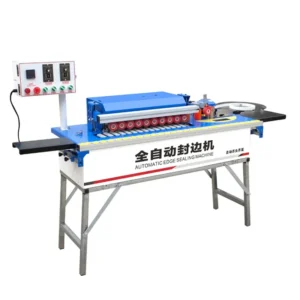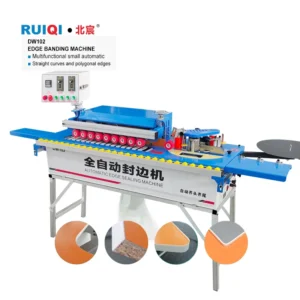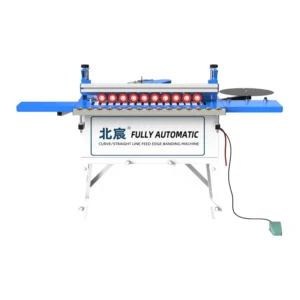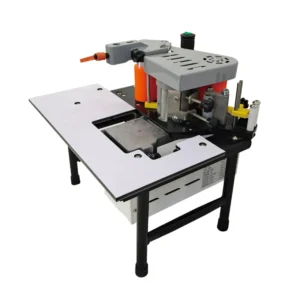
Description
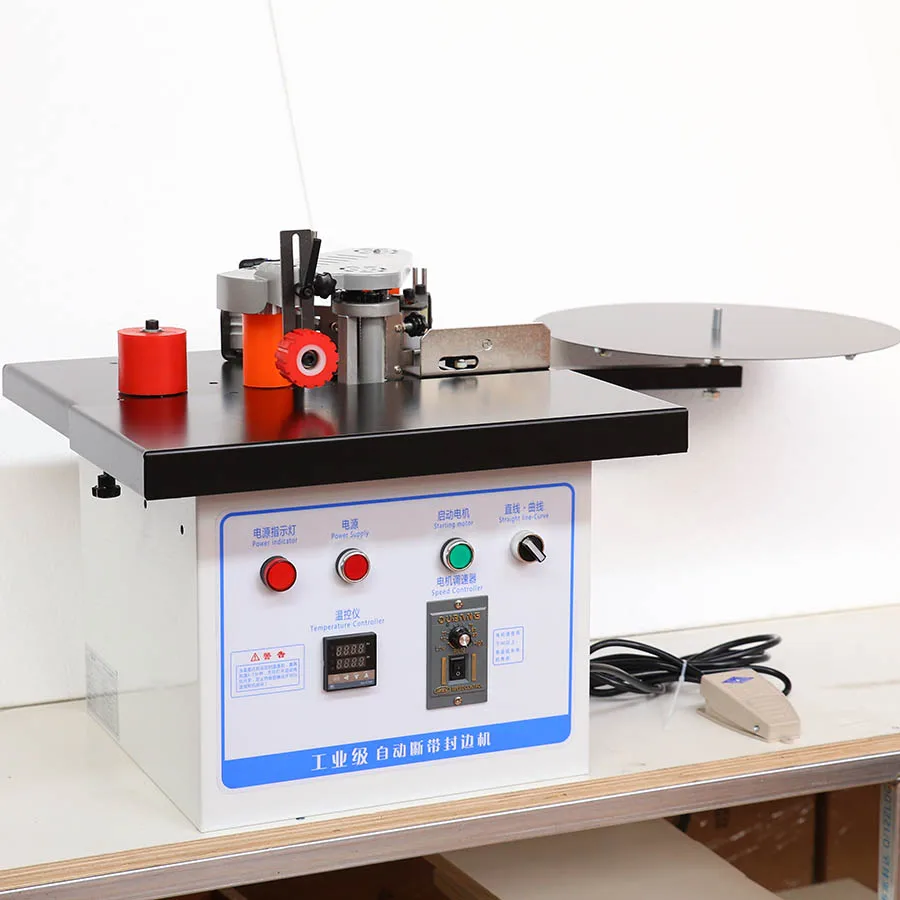
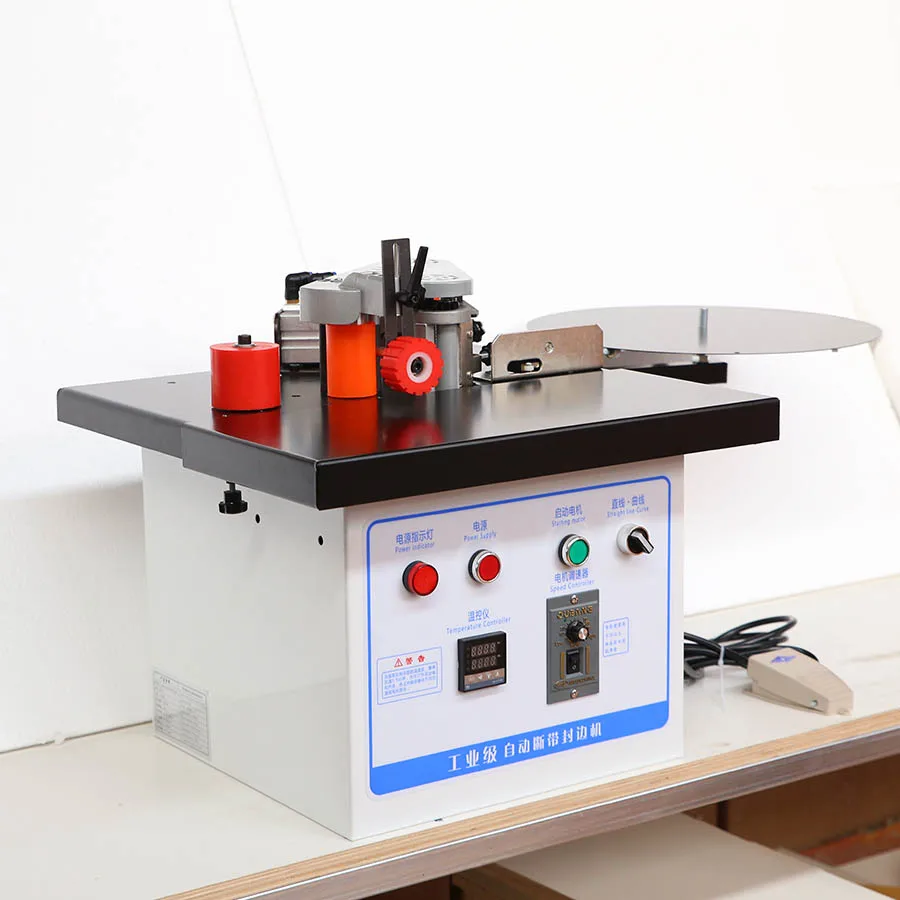
Stock Verification Before Dispatch — every ZDSF50 unit undergoes voltage, language panel, and functional verification before leaving the warehouse, eliminating on-site surprises.
Technical Specifications
| Parameter | Value |
|---|---|
| Model | ZDSF50 |
| Product Type | Semi-Automatic Edge Banding Machine |
| Rated Voltage | 220V |
| Power | 1.2 kW |
| Gluing Method | Double-sided via heated rollers |
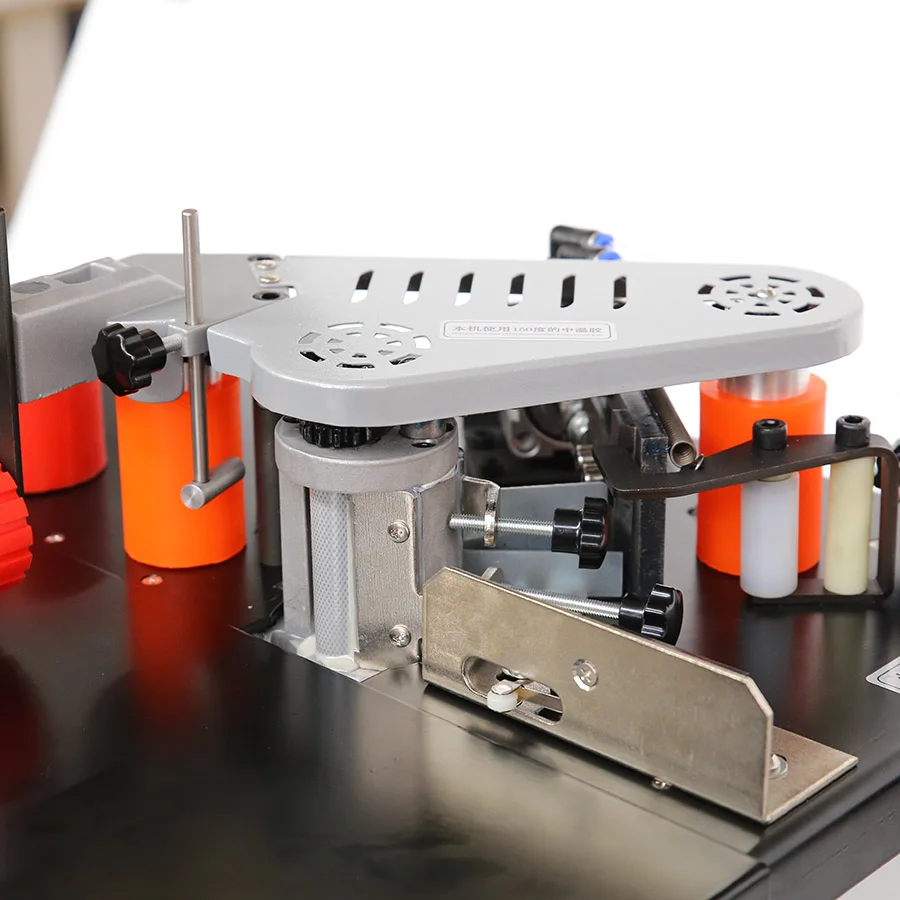
| Heating System | 4 heating tubes |
| Heating Time | 5-10 min |
| Glue Pot Capacity | 1000 ml |
| Edge Banding Speed | 0-6 m/min |
| Strip Thickness | 0.5-1.5 mm |
| Sheet Thickness | 10-60 mm |
| Rated Air Pressure | 0.4-0.6 MPa |
| Straight Edge Belt Breaking | Automatic via travel switch |
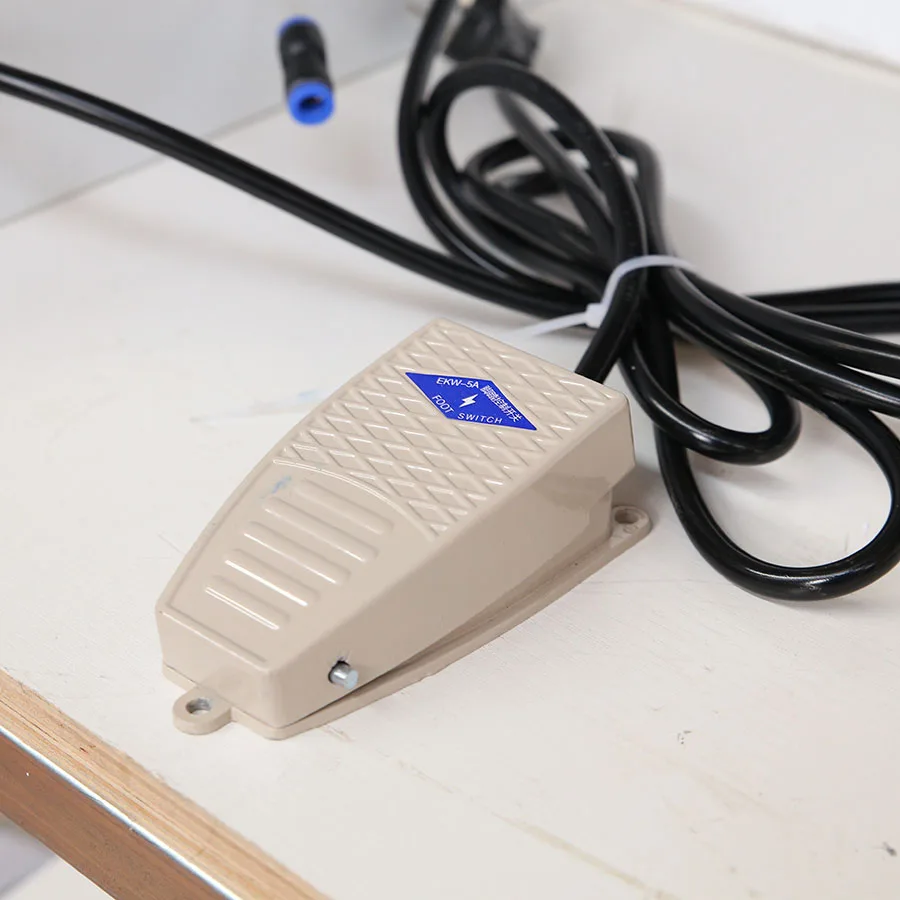
| Curved Edge Belt Breaking | Pneumatically controlled with foot switch |
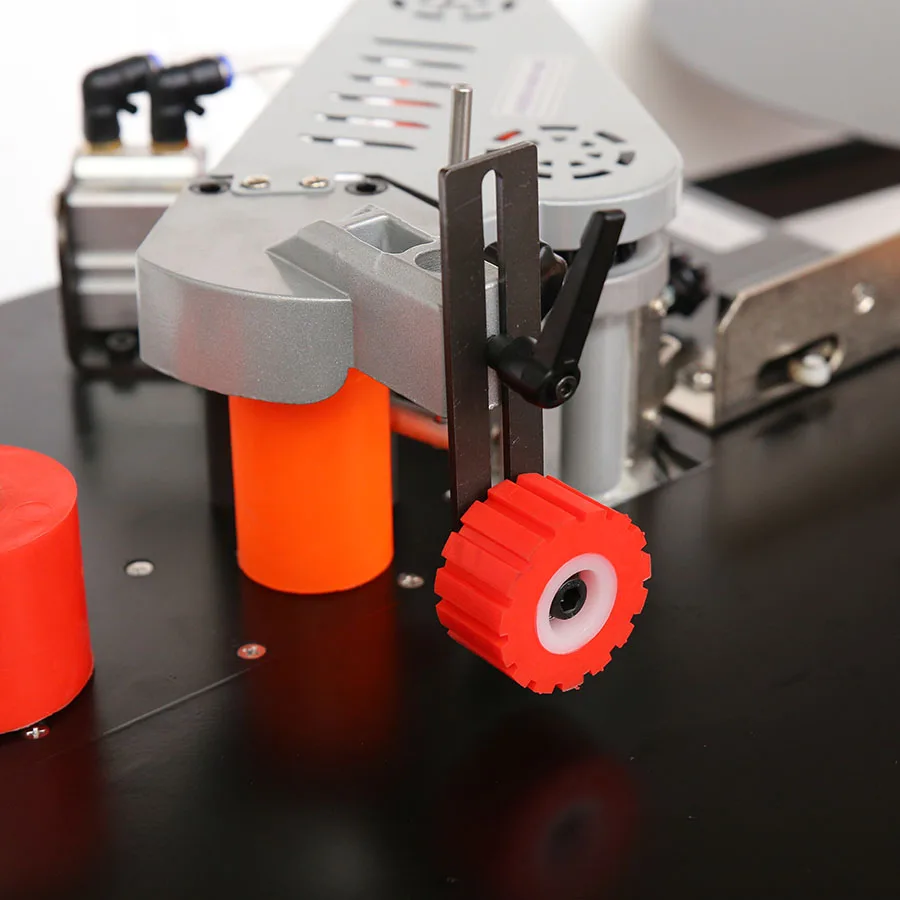
| Pressure Rollers | Adjustable, rubber material |
| Overall Dimensions (L×W×H) | 54 × 54 × 56 cm |
| Net Weight | 26 kg |
| Certification | CE |
Application Suitability
| Application | Material or Output |
|---|---|
| Small workshop straight edge banding | MDF and particleboard panels with PVC strips |
| Curved cabinet component finishing | Plywood shaped edges with veneer banding |
| Custom furniture prototype production | Solid wood panels with 0.5-1.5 mm edge strips |
| On-site mobile joinery work | Lightweight panels requiring portable edge treatment |
| Joinery operations transitioning from manual methods | Sheet stock 10-60 mm thick with standard edge materials |
Why the Voltage Question Should Come Before the Price on a Mini Edge Banding Machine in Stock Fast Delivery
Confirming your workshop supply before dispatch prevents weeks of downtime and motor replacement costs.
A few years back, a semi-automatic edge bander shipped to a Middle East customer arrived with a 440V motor. Their shop ran on 380V. The motor burned on first startup. The factory sat idle for three weeks waiting for a rewind. That single oversight cost more than the machine itself in lost production time. Every ZDSF50 unit leaves the warehouse with the buyer’s voltage confirmed against a photographed electrical panel — not a checkbox on a form [NEED_CITE: voltage and frequency standards by export market].
Stocked Configuration With Verified Electrical Compatibility
This ZDSF50 semi-automatic unit ships in a 220V configuration that matches standard single-phase workshop supplies across multiple regions. The 1.2 kW motor draws well within typical branch circuit limits, meaning most small shops can plug it into an existing outlet without commissioning a dedicated feed. Before dispatch, the voltage rating is cross-checked against the buyer’s confirmed electrical specifications, reducing the risk of a motor mismatch that leaves a machine sitting unpowered on the shop floor.
Rapid Dispatch Without Sacrificing Pre-Shipment Checks
A mini edge banding machine in stock fast delivery should not mean skipping verification. Each unit undergoes a functional test cycle before crating — the glue pot heats through its full range, the pneumatic belt-breaking mechanism fires on both straight and curved modes, and the foot switch response is confirmed. The pre-shipment test record travels with the machine so the operator can see what was verified before it left the floor. This approach keeps the dispatch timeline measured in days rather than weeks [NEED_CITE: CE machinery directive requirements for industrial equipment].
What the Speed and Thickness Range Mean in Practice
The 0-6 m/min feed speed gives operators fine control when working curved profiles where the banding must follow a contour without lifting. At the lower end of that range, the double-sided glue application has more dwell time against the substrate, which matters when bonding veneer to porous MDF edges. The 10-60 mm sheet thickness range covers everything from thin shelving stock to heavy workbench tops, while the 0.5-1.5 mm strip thickness handles standard PVC and thin veneer without requiring tooling changes between jobs.
The Cost of Skipping Air Supply and Pressure Checks
Buyers sometimes overlook the 0.4-0.6 MPa air pressure requirement, assuming a portable unit does not need shop air. The curved-edge belt-breaking function depends entirely on pneumatic actuation. Without a compressor delivering stable pressure in that range, the strip will not snap cleanly at the end of a curved run, leaving material that must be trimmed by hand — defeating the purpose of semi-automatic operation [NEED_CITE: compressed air quality standards for pneumatic woodworking tools]. A small dedicated compressor rated for this pressure band is sufficient, but it must be in place before the machine arrives.
Why Verification at Source Matters More Than On-Site Fixes
The in-house configuration process covers voltage, control panel language, and spare parts packing against a confirmed checklist. This is the same four-stage quality process applied to full production lines, extended to single-unit portable orders. When a fault does surface after arrival, the operation and maintenance manual — provided in the buyer’s agreed language — gives the operator troubleshooting steps without waiting for a translated phone call across time zones.
Documentation & Verification
- Voltage confirmation sheet matching your workshop’s photographed electrical panel
- Pre-shipment functional test record covering glue heat cycle and pneumatic response
- Operation and maintenance manual supplied in your operator’s language
- Spare parts list with part numbers for glue pot tubes and pressure rollers
- Packing photographs showing crate condition before the unit leaves the warehouse
Installation, Commissioning & Support
- Requires a single-phase 220V circuit rated for at least 1.2 kW continuous draw
- Air compressor delivering 0.4-0.6 MPa must be connected before first curved-edge run
- Unit arrives fully assembled at 26 kg — two people can place it on a standard workbench
- Glue pot reaches working temperature within 10 minutes on first startup
- Adjustable rubber pressure rollers set once per sheet thickness range to maintain contact
- Foot switch position verified during commissioning for comfortable curved-edge operation
What We Need to Move Your Order Forward
To confirm the right configuration, share your workshop’s voltage and frequency rating along with a photo of your electrical panel nameplate. Let us know the primary sheet materials and edge strip types you plan to run so we can verify compatibility against the 10-60 mm thickness range and 0.5-1.5 mm strip capacity. If you need the control interface or manual in a specific language, confirm that at the time of order so it is prepared before dispatch.
Frequently Asked Questions
Q: Is this mini edge banding machine in stock and how fast can it be dispatched?
A: The ZDSF50 is maintained in ready-to-ship stock. Once voltage, language, and spare parts requirements are confirmed, the unit goes through its pre-shipment test cycle and is typically dispatched within a short window. Single-unit orders carry the same verification process as larger batches, so there is no minimum order quantity delaying a small workshop purchase.
Q: Does the 220V configuration match my local power supply, and can other voltages be ordered?
A: The standard stock configuration is 220V single-phase, which matches workshop supplies in many export markets. Before dispatch, we confirm your local voltage and frequency against a photo of your electrical panel nameplate. Other voltage configurations from 110V to 440V are available, though they may require a short preparation window rather than same-day dispatch from stock.
Q: What edge banding materials and strip thicknesses does the ZDSF50 handle?
A: The machine processes PVC and veneer edge banding strips in the 0.5-1.5 mm thickness range. The double-sided heated roller gluing system bonds these materials to MDF, plywood, particleboard, and solid wood panel edges. Sheet stock from 10 mm to 60 mm thick is accommodated by the adjustable rubber pressure rollers without tooling changes between standard thicknesses.
Q: How is curved and shaped edge banding performed with this portable unit?
A: For curved profiles, the operator uses the pneumatic foot switch to control belt breaking manually, snapping the strip at the right point along the contour. Straight edges use an automatic travel switch for hands-free strip cutting. The 0-6 m/min variable feed speed lets the operator slow down on tight radii to keep the banding seated firmly against the curved substrate.
Q: What documentation and manuals ship with the machine?
A: Each dispatched unit includes a CE declaration of conformity, a pre-shipment test record, an operation and maintenance manual in the agreed language, a spare parts list with identifiable part numbers, electrical schematic with confirmed voltage, and packing photographs. Customs documentation support is provided to smooth the import process at the destination port.