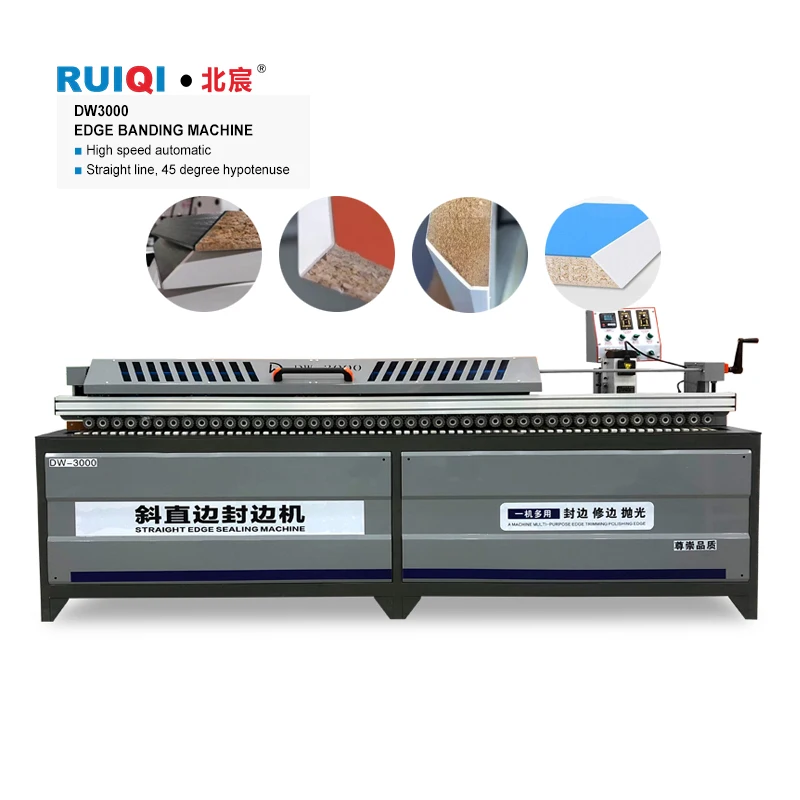
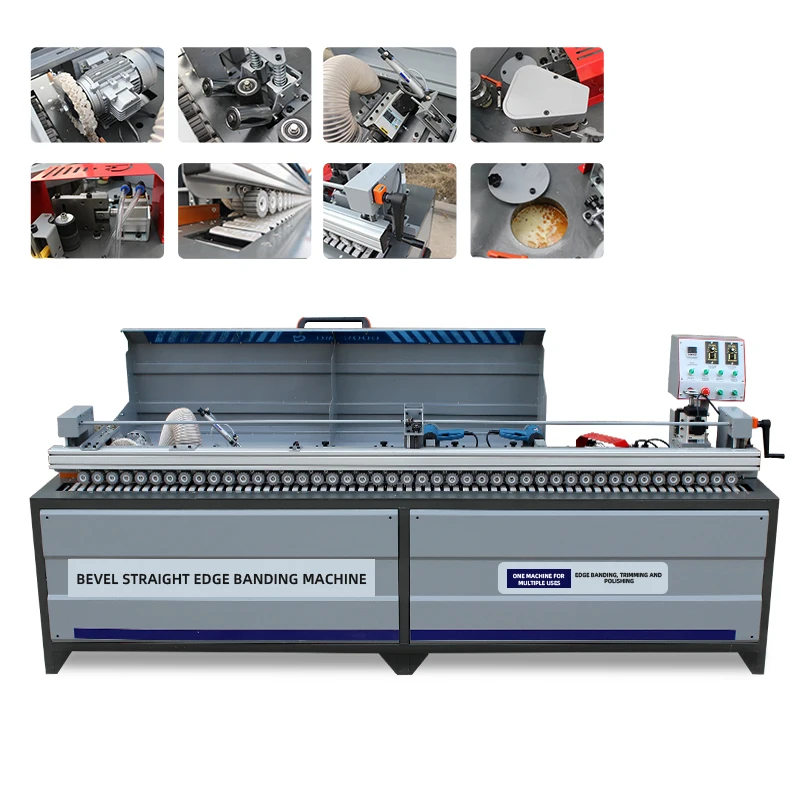
Description
Dispatch-Ready Configuration — every DW3000 unit ships only after your local voltage, frequency, and operator language are confirmed in writing and verified on the factory floor.
Technical Specifications
| Parameter | Value |
|---|---|
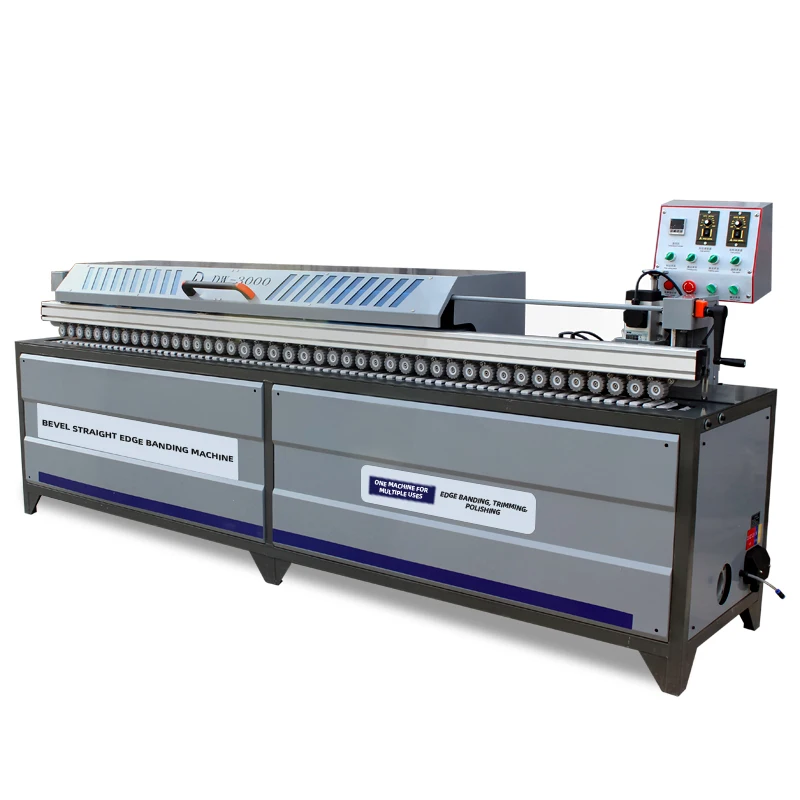
| Model | DW3000 |
| Product Type | Automatic Edge Banding Machine |
| Total Installed Power | 11 kW |
| Voltage Options | 380V / 415V (frequency and phase to be confirmed per destination market) |
| Feed Speed | 0–12 m/min via 160W variable-speed motor |
| Transmission Speed | 0–12 m/min via 180W motor |
| Edge Banding Height Range | 0–50 mm |
| Edge Banding Thickness Range | 0.3–3 mm |
| Minimum Sheet Length | 30 cm |
| Minimum Sheet Width | 15 cm |
| Pre-milling Motor | 2.2 kW |
| Heating System | 2.2 kW × 2 (dual hot air guns) |
| Trimming Power | 2.2 kW × 2 (spindle trimming motors) |
| Polishing Power | 0.4 kW × 2 |
| Vacuum Power | 550 W |
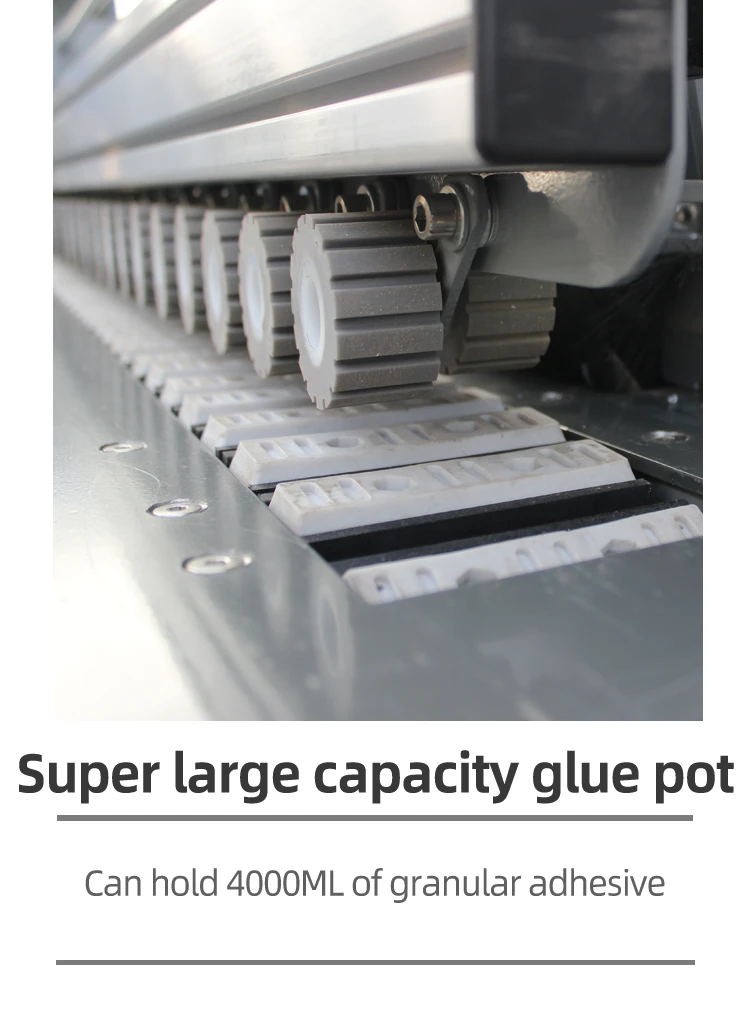
| Glue Pot Capacity | 4000 ml |
| Oblique Pressure Wheels | 8 sets, adjustable 30–90° |
| Air Source Pressure | 0.5–0.7 MPa |
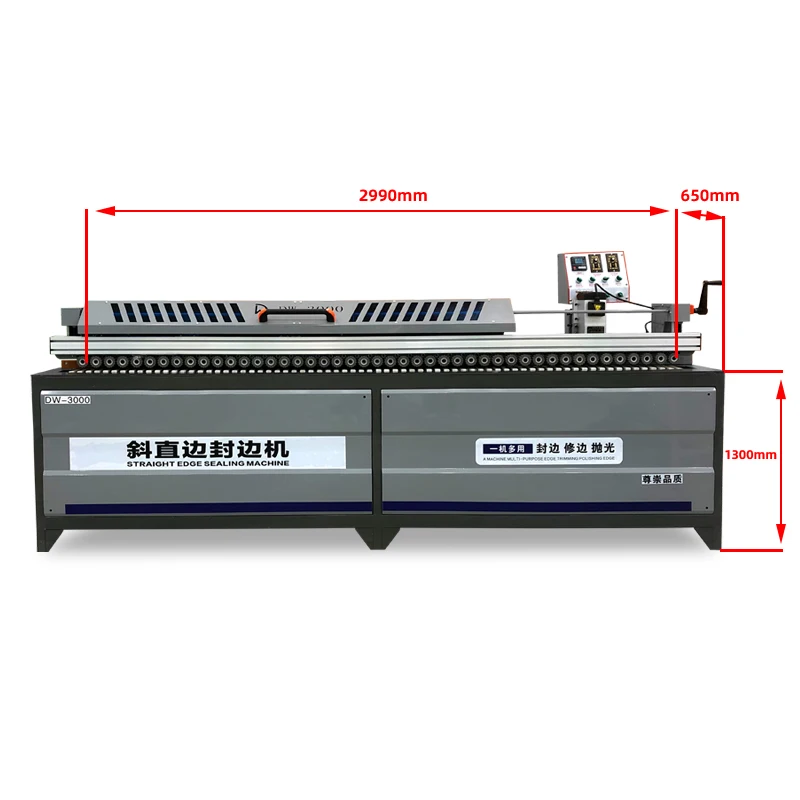
| Machine Dimensions | 299 × 65 × 130 cm |
| Machine Weight | 430 kg |
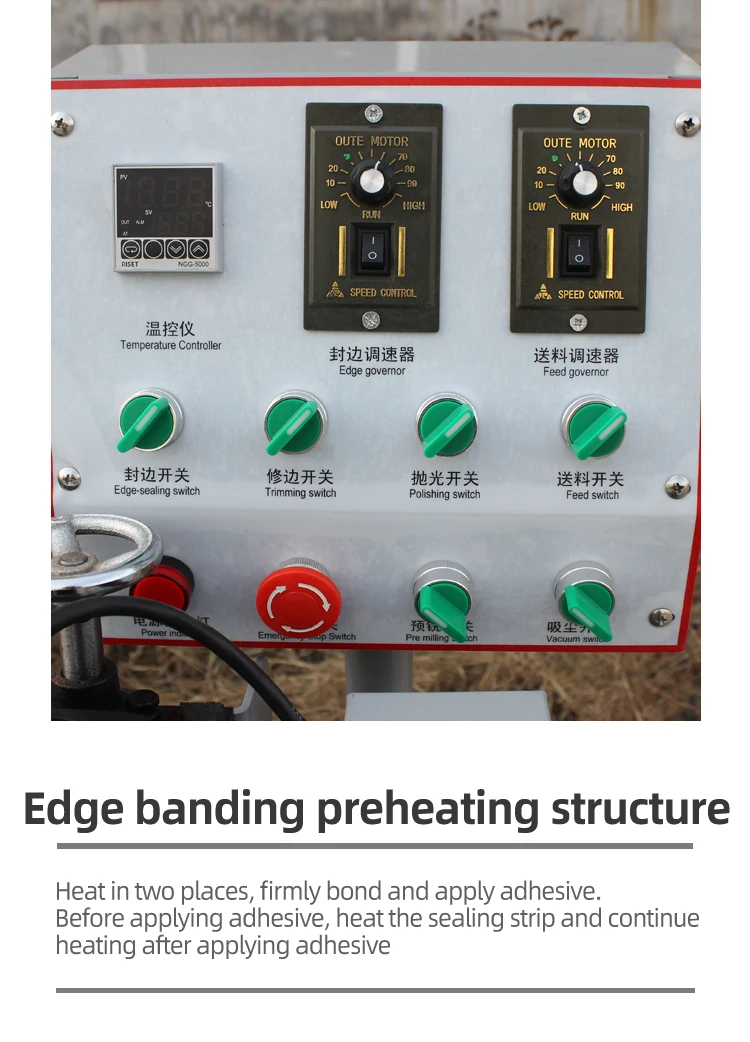
| Control Panel Language | Chinese / English standard; Spanish, French, or others available |
| Plug Options | EU, USA, AU, UK |
| Assembly State | Fully assembled prior to crating |
| Certification | CE; manufacturing under ISO 9001 |
Application Suitability
| Application | Material or Output |
|---|---|
| Cabinet door and carcass panel banding | MDF and particleboard with PVC edge banding |
| Custom furniture straight-edge finishing | Plywood and melamine-faced board |
| Beveled edge profiles for decorative panels | 30–90° oblique cuts on MDF and particleboard |
| Slotting for shelf pin or hardware insertion | MDF and plywood panels within 0.3–3 mm banding thickness |
| Small-batch production runs | Panel furniture requiring trimming, scraping, and polishing in a single pass |
Why the Voltage Question Must Come Before the Order
An automatic edge banding machine in stock means nothing if it cannot be powered on the day it arrives at your workshop.
I spent three weeks troubleshooting a shipment that landed in a West African port with the wrong voltage configuration. The machine was mechanically perfect, but the local grid did not match the electrical specification that had been assumed rather than confirmed. The customer lost production time, paid for an on-site electrical retrofit, and lost confidence in the process. Since that experience, I verify every single-unit dispatch against the buyer’s written electrical confirmation before the crate is closed. [NEED_CITE: voltage and frequency standards by export market]
Stock Availability and Dispatch Timing
This DW3000 automatic edge banding machine in stock is held in fully assembled condition at the Shandong facility, meaning the typical lead time from order confirmation to crating is measured in days rather than months. The machine leaves the factory with all stations — pre-milling, edge banding, trimming, scraping, polishing, and vacuum extraction — already calibrated and test-run on representative panel stock. Buyers ordering a single unit for workshop commissioning can expect the same preparation protocol as a multi-unit production line order.
Configuration Before the Crate Closes
The value of buying from stocked inventory is speed, but speed without verification creates downstream failures. Before dispatch, the electrical configuration is matched to the destination market’s voltage and frequency. The control panel language is set so the operator can read instructions on day one. Plug type is swapped to match local socket standards — EU, USA, AU, or UK — so the machine can be connected without sourcing adapters that introduce connection faults. [NEED_CITE: CE machinery directive requirements for industrial equipment]
How the DW3000 Handles Real Panel Work
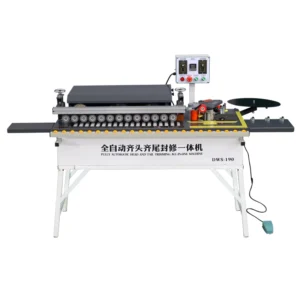
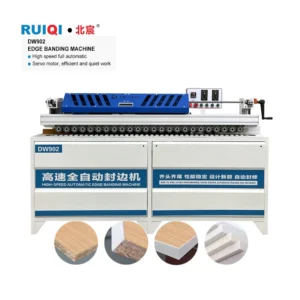
The dual 2.2 kW heat guns maintain consistent glue activation across both PVC and veneer banding materials, which matters when a single production run mixes substrate types. Eight sets of oblique pressure wheels adjust from 30 to 90 degrees, allowing the machine to apply compliant pressure on bevel-cut edges without leaving gaps in the glue line. The 4000 ml glue pot provides sufficient capacity for extended runs without interruption for refilling, while the double cylinder feeding belt at 0–12 m/min keeps panels stable through the trimming and scraping stations. Pre-milling at 2.2 kW cleans the panel edge before banding, removing saw marks that would otherwise show through thin PVC. The 550 W vacuum system captures dust and trim waste at the source, reducing post-process cleaning time on the shop floor. [NEED_CITE: edge banding adhesion standards for MDF and particleboard substrates]
The Hidden Cost of Skipping Configuration Checks
When a machine arrives with the wrong voltage, the problem is not just the motor — it is every control relay, heating element, and variable-frequency drive in the cabinet. Retrofitting on-site means opening the electrical panel in a workshop environment that may lack the tools and diagnostic equipment of the factory. Operators then work with a control panel they cannot fully read, leading to parameter errors that surface as inconsistent trimming depth or uneven glue application. These faults are often blamed on the machine itself, when the root cause was a missing confirmation step before shipment. [NEED_CITE: common causes of edge banding machine commissioning failures in export markets]
Why Buyers Source This Model Here
The DW3000 sits within a product family that scales from entry-level to full-function configurations, so a workshop can add capacity later without changing supplier. Every unit undergoes four-stage quality control covering incoming material inspection, in-process checks, finished product verification, and a pre-shipment test run with photographic documentation. Voltage, plug type, and control language customization are treated as standard procedure, not special requests. Engineer-led configuration recommendations are provided with formal quotation, ensuring the machine matches the buyer’s actual panel types and daily throughput rather than a theoretical maximum. Factory visits are welcomed for buyers who want to see the test run in person.
Documentation & Verification
- CE declaration of conformity specific to the DW3000 edge banding machine configuration shipped
- Factory test record showing actual banding results on your specified panel thickness and edge material
- Electrical schematic with confirmed voltage, frequency, and circuit breaker ratings for your site
- Operation and maintenance manual printed in the operator’s agreed language at time of dispatch
- Spare parts list with part numbers matching the exact components installed on your unit
- Packing photographs documenting machine condition and crate integrity before container loading
Installation, Commissioning & Support
- The 299 × 65 × 130 cm footprint requires a clear floor area with level concrete substrate and 130 cm overhead clearance.
- A dedicated 380V or 415V circuit rated for 11 kW total load with appropriate local isolation switch is required before delivery.
- Machine ships fully assembled; uncrating and positioning require standard workshop lifting equipment for the 430 kg unit weight.
- First power-on includes verifying all station motors, heat gun temperatures, and feed speed calibration against your actual panel stock.
- Operator training covers glue pot loading, pressure wheel angle adjustment for 30–90° bevels, and flexible scraper setting.
- Included spare parts cover initial wear items; replacement ordering uses the part-numbered list supplied with documentation.
What to Provide With Your Inquiry
To configure the DW3000 correctly for your workshop, share your local voltage and frequency, the edge banding materials and thicknesses you run most often, and your preferred control panel language. If your existing equipment has specific feed height or throughput requirements, note those so the machine integrates without bottleneck. Confirming your plug type and whether you need a sample test run on your own panel stock before shipment will accelerate the dispatch timeline.
Frequently Asked Questions
Q: Which DW3000 units are currently available and what is the dispatch lead time?
A: Stocked DW3000 machines are held fully assembled and can typically be crated within days of configuration confirmation. Lead time from order to dispatch depends on how quickly voltage, plug type, and language preferences are finalized. Once those details are locked in writing, the pre-shipment test run is scheduled and the unit moves to packing.
Q: Can I verify voltage, frequency, and plug type before the machine ships?
A: Yes. Every DW3000 order requires written confirmation of destination voltage, frequency, and phase before the electrical cabinet is finalized. An electrical schematic is provided showing the confirmed configuration. The correct plug — EU, USA, AU, or UK — is installed at the factory so the machine connects directly on arrival.
Q: What edge banding materials does the stock DW3000 handle?
A: The machine processes PVC and veneer edge banding from 0.3 to 3 mm thickness, with edge banding height from 0 to 50 mm. The dual heat guns and eight adjustable pressure wheel sets handle both straight and 30–90° oblique bevel profiles on MDF, particleboard, and plywood substrates.
Q: How is a single DW3000 unit packed and shipped?
A: Each machine is fully assembled, tested, then secured in a crate with packing photographs taken before closure. Shipping options for single-unit orders include standard container consolidation or dedicated LCL arrangements. The 430 kg machine weight and 299 cm length are factored into freight quotations provided at order stage.
Q: What spare parts come with the machine and how are replacements ordered?
A: A spare parts list with numbered entries matching your specific unit is included at shipment, covering initial wear items such as trimming blades and scraper elements. Replacement orders reference these part numbers for accurate fulfillment. The operation manual includes maintenance intervals for each station to guide ongoing parts planning.